
Refining


At this point I was pretty set on my outcome, the main focus this week for me was to develop a balanced visual language that will engage the audience as well as appeal to the medical field, keeping a professional, trustworthy look.
After trying out a few names along the themes of ‘clear, care, space, mind, your’, I came across the name ‘Yuu’ – the misspelling made the term ‘you’ much less direct and more welcoming.
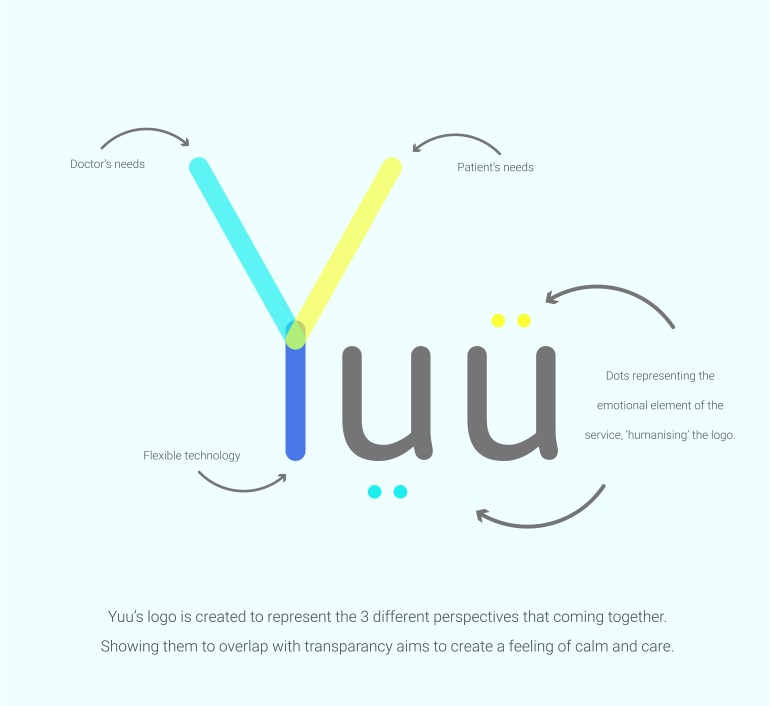
I know that the font had to keep up this positive, welcoming persona so experimented with a few similar font’s, and although most of the u’s were fine I decided I wanted to created my own Y for the logo. This allowed me to create this overlapping effect to reflect on the 3 different perspectives that were present within this project. Originally I left it as just that, but later went back to add in the dots above and below the u’s to represent the emotional aspect of it in attempts to humanise the logo.
To ensure that this project stayed somewhat inline with existing medical services and sites, I chose to use a selection of two different blues in the logo. Blue is used often within the medical field as it typically conveys and element of credibility, trust, knowledge, power, professionalism, cleanliness, calm and focus. However, this is a site that will be delivering medical care with a twist of creativity, so with that in mind I threw in the yellow. I feel this brings a refreshing sense of optimising and happiness that you may not see too often on similar sites.

The site’s visuals remained consistent with the logo, playful yet professional with elements of creativity and calm. To make sure that the visuals didn’t become too random/busy, the site icons are based on elements that can later be found in the visual outputs.
To make the site feel like a secure, safe place I wanted to embed some form of calming animation on the site home page – and what better way to do this than making it interactive? Keeping with the theme of the brand, I decided it would be ideal to make the home page have circles that interacted to your mouse movements. Luckily, my brother is currently learning coding and managed to form an idea of what this would look like for me.
I feel that this could really help someone that is perhaps feeling on edge calm down or begin to engage with the idea of using this site to help them.
Testing
As I had already reached out to members of the public about my project concept, I sought out to gain further feedback from people within a medical field. After preparing a brief overview of my project, Yuu, I got in touch with Alison Robson, a Paediatric Nurse at Airedale Hospital & Kate Smith, a Research Sonographer at Leeds Musculoskeletal Biomedical Research Unit.


Q – After reading through this brief, do you have any feedback on this project? For example, do you think this is something that would help?
AR – I think this is brilliant, in paediatrics we encourage children to use visualisation and art to help them express their feeling for children with anorexia and mental health problems they use or are encouraged to use a diary. Also, they use CBT therapy via a website. But Yuu sounds like an amazing tool.
KS – I think this is great and outlines the overall concept well. Maybe a little more explanation as why visualisation can help and why receiving their own personal Art is useful?
Q – In terms of aiding the doctor, do you think it will be helpful for them to be able to see information before hand?
AR – Absolutely Drs can only be guided by what the patients say, and when sat in front of a Dr people can become flustered/ rushed with only 5 min appointment times So from a Dr and patient point of view think it would greatly benefit both parties.
KS – I think the idea of writing problems down and sending them through sooner is great – many people find it easier than talking. It also allows the GP to find out info beforehand if required. I would also maybe somehow ask the patient to prioritise as it may be the 5th thing down the list that they have just been brave enough to write that is the most important to them – maybe a training factor for healthcare professionals. (Although they probably know this!)
Q – when you say they try to get children with mental health to use visualisations, what kind of stuff is it? Pictures, shapes, colours?
AR – We get kids to draw, paint, modelling clay, colouring book anything really to get negative/ harmful thoughts out and them get them to draw or visualise their happy place if that makes sense.
 Sian Laüra