
“Life is 10% what happens to you and 90% how you react to it.”
After taking a step back to look at my work style, I’ve noticed that it all seems very… sporadic. There’s usually numerous bits of pieces here and there of an idea before they all eventually fall together – or alternatively, there’s isn’t anything at all but a very sudden movement of production that has led to an creative outcome. And it left me wondering why.
Some light was shed on this after I learnt about Edward de Bono’s Six Hat Theory. This is a model that allows for people to address and overcome complex situations from all angles, making sure everything is covered.
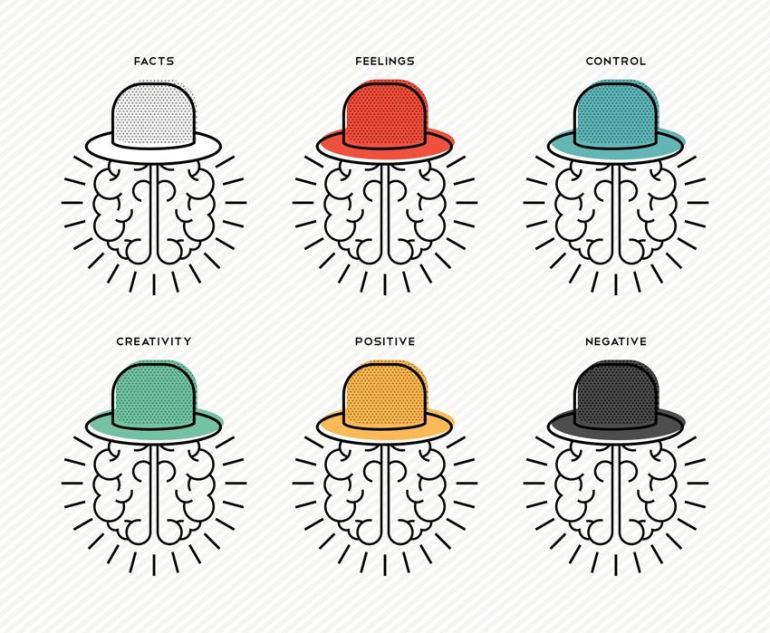
Using this model allows for anyone one person or a group to see a problem in a new light as they switch ‘hats’ to focus on different aspects of a problem. If used correctly this should overcome the use of argument to discuss and/or explore a problem as it allows for every member to think in parallel constructively, without any idea being unheard or dismissed. Not only does this allow for a calmer, thorough discussion but it also lifts any restrictions of ideas that may of existed in a conflicted environment.
I linked this back to my style of work – as perhaps when I’m scribbling down notes without much though, this is my green hat coming into play. And when I later go to make sense of these notes, these could be an examples of my yellow & black?

But surely there’s more to this, if there are different roles of thinking. Surely there are different styles within each role? Not every creative moment has the same flare, emotions flicker and change weight constantly.
I began researching into how mood can affect creativity, productivity and overall thought processes.
““A large body of empirical evidence has shown that negative affect-–depressed and anxious mood–-is associated with reduced cognitive performance and lower cognitive flexibility,” says Von Stumm. In other words, if you’re feeling moody at work, no matter how determined you are to get the job done, your productivity and creativity will suffer.“
I found an interesting article written by Michael Grothaus, Unravelling the surprising relationship between mood and productivity. So, this article basically did what it said on the tin, but it also explored how we can adjust or manage our productivity levels by becoming aware of our moods. “It’s easier said than done, but when you notice your mood becoming unstable, take a step back, try to identify the source of stress, and eliminate it. Sometimes it’s enough to become aware that a situation is stressful for us to find our balance again.” says Sophie von Stumm, senior lecturer in psychology at Goldsmiths, University of London.
The more I read the more it became clear that my emotions have a powerful influence on my creative process and overall outcome. I have random bursts of creativity, which unfortunately seem to go to waste unless I take action at the time. So I’m going to be thinking of new methods I can use to be able to manage this or maintain that creative energy for a longer duration.
Notes & Ideas


The moment I read the words ” process and summarise in a black line drawing” it was instant, I had a pen to paper drawing out a line to replicate my creative mind journey. At the time I didn’t really know why I had done it or what exactly I planned to do with it. I just, did it.
I returned back to it the next day and evolved it into an idea. After some reflection it became clear to me that most of my creative ‘sparks’ seem to come from my subconscious, acts of ‘just doing’, and this was one of them. After only a brief amount of time spent analysing the movements of the pen I noticed that this was a construction of energy at the time. This was a reflection of how I would of tackled a creative task at that moment.
Looking back at my previous drawings and designs I noticed that this was a continuous trait amongst them all. Each one had a different style and outcome due to my mood at the time of creation. So rather than it being a subconscious guide to whichever design I was to pursue next, I thought I’d give it it’s own limelight.
I was going to re-create a series of mind process diagrams dependant on mood. The moment this was decided I knew I was going to have to bring colour as an attributing factor. It just seemed unnatural not too.

I began with a mind map to gather a collection of moods and how I would describe each one. To give myself a scale to work with, I decided that the part of the piece that would be acting as the ‘Y axis’ would be a scale on happiness/motivation, as I find that when I’m low my motivation is very likely to match this. The ‘X axis’ would then represent the duration of time I had spent on a project.

To create the line diagrams I knew it had to be on a first take basis only, as otherwise my results wouldn’t be genuine. However, due to time restrictions I didn’t have time to wait until I felt these moods naturally – so in order for my to get the most accurate results with the time I used photos, music and objects to recall memories and feeling to bring myself into the mindset necessary. Then without question I just drew a line.


Once I had completed a diagram for each mood (Anxiety, Sadness, Happiness & Anger), I went back to analyse what I had created and began trying to make sense of each movement. A scribble in the lines seems to represent an internal battle of some kind, whether that being a huge realisation that a plan wasn’t going to work or just a small conflict of thought. I found it really interesting to reflect back on and found that they all had one similar pattern – each had a quick drop of emotion just before finalising a project.
I had found a colour diagram that I felt I related to most whilst researching other art that had been dedicated to mood. This was taken from a piece done by a Portuguese designer, Luis Giestas – “300 Days of Emotion Colour – Coded Diaries”. After picking out my colours for each mood instinctively this was one of the only wheels I saw that also reflected similar views.

Creation Process


I knew that working with pen or paint alone wouldn’t be able to portray the energy from each line correctly, so I decided to use coloured string for each line instead. This way I can bring it out of the paper enough for each line to have a stand alone aesthetic whilst being able to keep the movements of each lines as authentic as possible – using a hot glue gun to keep them static.
Although I intentionally thought of creating individual diagrams, I decided to overlap them to make it more of a direct comparison. Also doing it this way amplifies the differences of energy and emotion between each one which created a much more lively result.
Using pencils for the first draft, and a coloured pen to finalise the lines I managed to re-create each diagram onto card. Then all that was left to do was hot glue the string into place!
I chose to layer them in order of how dominant I perceived each mood to be to my creative process – from lowest to highest; Anger, Sadness, Anxiety, Happiness.


I hadn’t initially expected the glue to dry as fast as it did, which led to some misplacement and a few rips (ironically I had started the on the Anger line when this happened!). At this point I accepted that this wasn’t going to 100% within the original lines and that there was going to be glue showing in parts. This is something I believe I could overcome after dedicating some time to practising, but as this was my first time using a glue gun, I was willing to let it go.


This experience has has made my analyse everything, intentional or not. Now I’m not sure if this is just me over thinking (not uncommon) or not. But I found it really interesting and/or ironic that even the way I unravelled the string seemed to be a reflection of my mood. Anxiety , unravelled and uncontrollable. Happiness began to get messy, almost looks excited? Sadness has slight movement but remained pretty lifeless & Anger stayed stern and barely touched.
Outcome


It was really insightful following each line I had made so precisely. It gave me time to understand each movement. In fact, whilst creating it I did feel myself reliving some of the emotions each line was portraying. I wondered if this type of communication and/or empathy could be experienced or at least understood by another person or if this something that could only be relived first person.
This project was one of my most favourite methods of working. Firstly because I genuinely didn’t expect that the outcome would look anything like it did. I am so glad that I decided to cross each diagram over the other rather than keeping them separate, I love the contrast of each line and really enjoy the crossovers. And secondly, this design had the most direct reflection of myself, being that it was a literal diagram of my mind processes. I enjoyed mapping information out in a visually way and I believe there is something really beautiful about the simplicity and honestly of it.
This style of working is something I’d like to expand as I believe there’s a lot of potentials ways to take this.


 Sian Laüra
Thoughts on ideas
Great documentation of process – but consider how you photographically document your work – think about framing and cropping and lighting and telling a story that is beautiful and engaging through the way you document your process, It is a project in itself. Your string drawings could become a whole new body of work if documented well. Zooming right in, working with physical L shape crops. Framing and reframing. Documenting as a whole but also in parts. How to edit, how to sequence how to best tell the story of your outcome and your process. Giffs, Animations, books…. Go for it! Love the hands on approach – now how to use and develop your design skills to convey that work… You are also lacking any research that links to what you are doing, the way you are investigating, who else works in this way? Where are you drawing inspiration from. It comes from within but you need to broaden your research and thinking and reflect not only on your own work bt those of others, historically and now…
LikeLike