
Further Feedback
Nice idea but this would never be passed by the NHS as it would it be too time consuming for a DR. This should be described as a tool to aid social prescribing, rather than involving the GP. Look up the new role ‘Social prescribing link worker’ and social prescribing in the new NHS 5 year plan. This is a new role that aims to take pressure off a GP and signpost the patient to the most appropriate non medical care. A surgery which has already implemented social prescribing successfully is Frome in Somerset, there should be plenty of info online. The social prescriber could manage this page and take more time assessing the patients need.

I had never heard of Social Prescribing before and once I began looking into the idea, it fit perfectly with the service that I had designed. Social Prescribing seems to be the perfect method of injecting the health care with what it needs the most – time. By implementing a middle ground system that can take that additional time to assess where the patient will receive the best type of care, you are saving both the patient and the GP’s so much time.
Social prescribing is when health professionals refer patients to support in the community, in order to improve their health and wellbeing.
Once I had carried out some further research into how Social Prescribing is currently working within the Frome practice, I found that the pitch of my project didn’t need to change too much to adapt to this new information. It will still remain a communication tool, but rather than it being used by the GP, it will instead be used to aid Social Prescribing.
Social Prescribing – https://www.england.nhs.uk/personalisedcare/social-prescribing/
Frome – https://www.local.gov.uk/somerset-county-council-using-social-prescribing-promote-self-care
https://shiftdesign.org/case-study-compassionate-frome/
Frome’s Model – https://healthconnectionsmendip.org/our-model/
Creativity
Extending on from the feedback I had received last week from Kate, who mentioned it may be worth concentrating more on the creativity aspect of the project – why was it important and how could it help?
Although there was already a creative output set in place, it currently just felt like an add on feature rather than something that was in the spotlight – so to embrace the visual arts and how they could help aid those with mental health issues, I decided to begin including it more into features available on Yuu.
For example – within Yuu Space, a space that would act like an online journal to the patient, I added creative tools so that the patient could input visual elements as well as written ones.


They’ll also be more coverage on the home page on creative groups and workshops that the patient could gain access to. Creative solutions to aid mental health issues are often overlooked as they can often be viewed as simply a hobby or a pass time. However there have been multiple studies that shine a light on the many benefits creativity can have on your mental health.
The average person has about 60,000 thoughts in a day. A creative act such as crafting can help focus the mind, and has even been compared to meditation due to its calming effects on the brain and body.
Creativity reduces anxiety, depression, and stress… And it can also help you process trauma. Studies have found that writing helps people manage their negative emotions in a productive way, and painting or drawing helps people express trauma or experiences that they find too difficult to put in to words.
By putting the creative solutions right next to the more commonly used methods, such as talking therapy, I aim to equalise the benefits that they can have and encourage patients to try them for themselves.
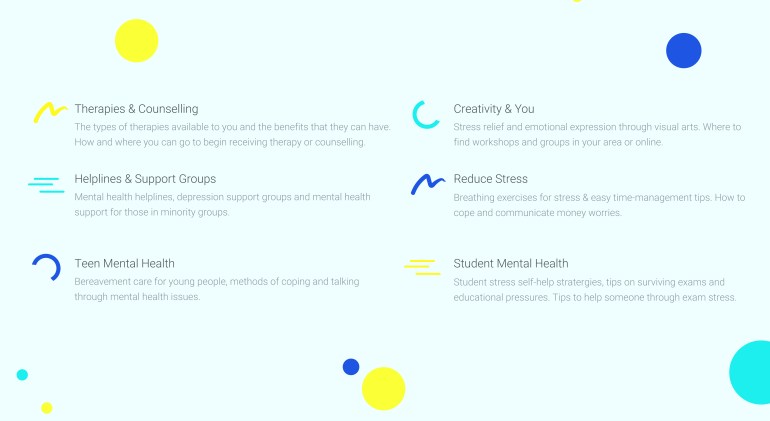
Initially, the project was aiming towards it just being a site that can be accessible to those that are referred to it, however due to features, such as the journal, I feel it would be best to make this service available as an app too. Patients that come to use the journal feature should be able to do this as and when they please to ensure they capture the genuine emotions they’re feeling at the time, so having the opportunity to pull out an app would be ideal. This would be a free app and to ensure that it is accessible to all it will be made available to all smart phones. Although the format may change somewhat due to the phone screens size difference, I would like to make it so that all features that are available on the site are also in the app. The only bonus feature of having it in an app, other than accessibility, would be that the patient could set up to have reminders or notifications if they desire.


I would later like to introduce some more opportunities for patients to access creative outputs directly through the site, like the drawing pad within the journal, however I do feel that I’ve covered more than enough grounds for this concept to launch and work efficiently as it is now. If I was to look into embedding new features into the app/site later down the line I would potentially look into local collaborations – this would hopefully lead to engaging the users in new forms of visual arts, workshops or even skill developments.
 Sian Laüra