
Alejandra Vidal & Danae Nunez – Spotter
Spotter aims to address clinical depression
It is widely accepted that sad music takes its toll on those suffering from depression. Spotter utilises Spotify data to know what kind of music people are listening to and for how long.
The campaign sends messages through Spotify ads to spread the word about helping depressed people and encourage the world to talk about it.
Through the project Spotter, Alejandra Vidal & Danae Nunez have found a unique way to source and target those that are silently suffering from mental health issues. I do believe this is something that would work and be able to provide assistance to those that need it, particularly due to it’s soft approach – by reaching those that may not be aware that they’re in need of some form of help, we could potentially nip the issue at the bud and see a huge reduction in severe mental health cases.
However, I do have some concerns due to the fact that is will initially come in the form of an advertisement, particularly as Premium Spotify users have signed up and paid to receive a service without advertisements. Although this is a service that is only trying to help, advertisements are often viewed as annoying and disruptive. So to avoid a negative connotations, I wonder if there could also be an area within Spotify that they could directly go to themselves – like a information hub for example.
Those slight concerns aside, I think this is an excellent idea and it shows great potential to help a lot of people who may of otherwise gone on without receiving any kind of help.
Fei Studio – Tear Gun

For Yi-Fei Chen, a graduate from Design Academy Eindhoven, her impossibility to speak up in self-defense during a confrontation with her tutors resulted in an internal burst of frustration, but externally only defenseless tears emerged. After that she decided to acknowledge this weakness, but reacting to it through her graduation project: “Tear Gun”, a minimal device that freezes tears instantly, ready to be fired in self-defense. According to Alessandro Ludovico (chief editor of Neural magazine) “The form she used to articulate and transform her uneasiness on both an intimate and a public level, has proven to be technically feasible and symbolically powerful, in a way that instantly makes it universal.“
Although the Tear Gun project isn’t a direct service that assists with those that struggle with their mental health, I feel that Yi-Fei Chen has done a fantastic job at creating a visual metaphor which people can empathise with. Many people who suffer from mental illness or are under chronic stress can find it hard to put how they’re feeling into words, never mind find the courage to actually voice them out loud. This project takes you on an emotional journey of a girl that has been in the same situation, and visually shows how she transforms her ‘weaknesses’ into a strength to fight with.
Unfortunately you don’t receive the full story through the video, so without the text to support the project you may not be able to grasp the full effects of the metaphor, but other than that I find it hard to pin point any more weaknesses within this project. I love the spirit behind this and in a way it showcases the strength behind those that are struggling mentally – turning what can so easily be showcased as a weakness or a burden into a full fledged weapon that you can rely upon to get you through your battles.
Ramon Telfer – Calmingstone
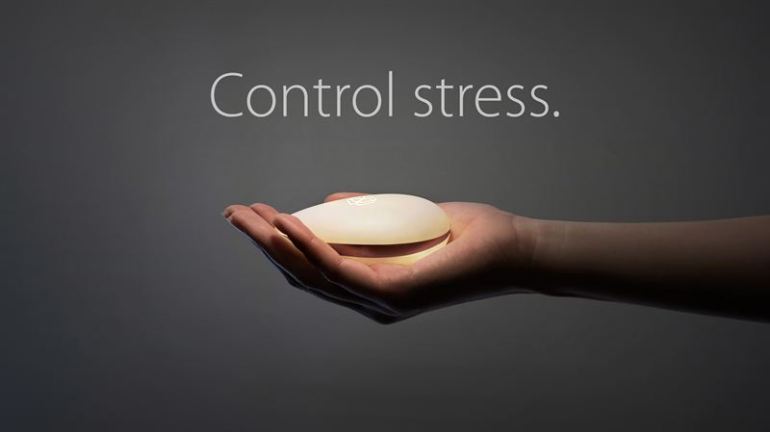
This pebble-shaped hand-held device eases anxiety through the use of light and sound.
Calmingstone was originally designed in 2014 by Ramon Telfer, who – after suffering with anxiety himself – found that there wasn’t a tangible product on the market to help him.
The Calmingstone project directly focuses on helping those that suffer with anxiety or panic induced episodes by bringing a physical, tangible object tool into play. Most people that suffer with anxiety/panic episodes can find themselves losing touch with reality, which can worsen their state. For this exact reason there are several mental exercises and steps that you can go through to try and ‘ground’ yourself or someone else when in a state of panic, however, due to the nature of panic it isn’t always easy to concentrate and put these into practice.
Calmingstone tackles this struggle by instead coming in a physical form, by being held in a person hands they are stimulating the sense of touch, making a stronger connection with the user and allowing them to find/ground themselves a little easier. I do like the idea of the users wellness being reflected back to them from the stone vibrations, glow and sound – but I also recognise that this may in fact induce more panic into some people. When you’re in a state of anxiety of panic, your heart rate will rise, and sometimes this can be extremely alarming – so I would worry that having this so clearly shown to you may just result in a repeated cycle of worry.
 Sian Laüra