
Design & it’s Audience
During Alec’s lecture he explored a number of case study examples of marketing strategies, one of which was The New York Public Libraries project, Insta Novels.
NYPL bring a classic example of how you can best bring your product directly to the audience, opposed to the audience finding your product by themselves. They knew exactly who they were targeting, where they were most likely to attract attention and design a product that would be accepted and used within the community. Rather than seeing the rise of technology as a hindrance to their business, they flipped it and made it work for them. Not only did this manage to bring classic literature culture into the modern day, but they’re likely to of saved money and resources having their stories in a digital format instead of printing additional books.
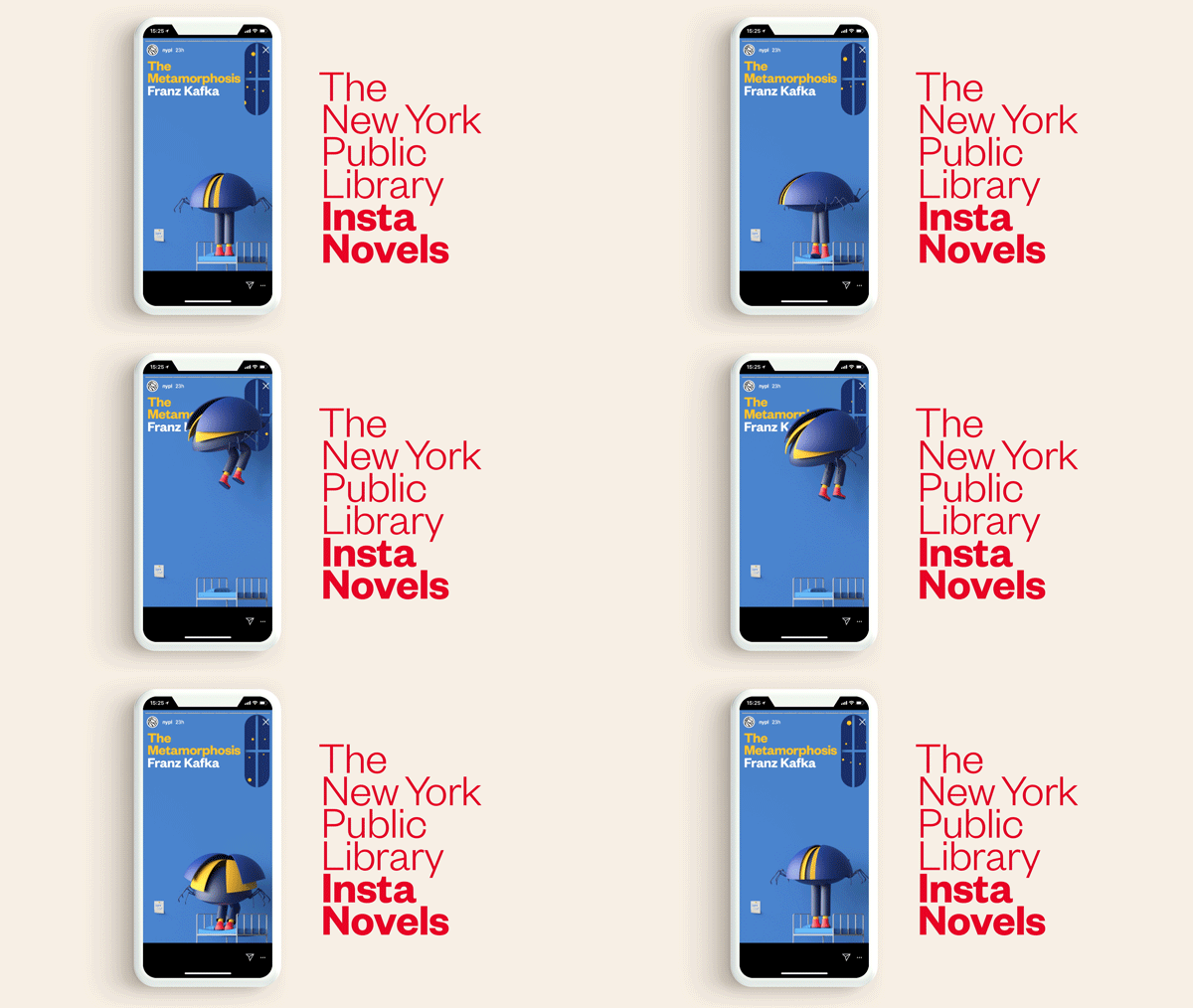
This type of marketing and product design is one I would certainly like to carry forward into my ‘APPY project as I feel it would work to my advantage, being that it is a lifestyle app that could hopefully gain a substantial social media following to support it.
Research & Design


These days we are consistently bombarded with different ways that we can allow technology to ‘help’ us via apps or websites. However, as most of these apps are typically free, this usually means that there are constant advertisements or locked elements that are only available if you sign up to a monthly paid subscription. To get all this in, in can sometimes lead to the apps become cluttered with ‘loud’ ads that are asking you to click them or sign up – from my personal experience this can completely overrule the most ‘calming’ of apps and instead make them generate more anxiety and stress than they seek to remove.
For example, here’s a screen shot from the lifestyle app ‘Fabulous’, “ascientific-based coach that helps you to reach your health and productivity goals.”.

This just seems like a lure, packaging further paid services in the form of a ‘gift’ from them to you. Personally I find it a little condescending and I don’t like the idea that they’re trying to act like they’re doing you a huge favour, when in fact it’s likely that after the year of a discounted price, they’ll raise the price without warning. Using phrases like ‘let’s see how you should approach this’ also implies that they’re your friend and are simply trying to offer you advice on how they can get the best deal, I find all of it a little suspicious and it completely breaks any trust I may of had with the app.
I do understand that some apps are put in place to generate money, however I believe there’s a more transparent way of doing this without coming across as manipulative. Especially when it’s an app is meant to be there to ‘support and motivate’ it’s users.
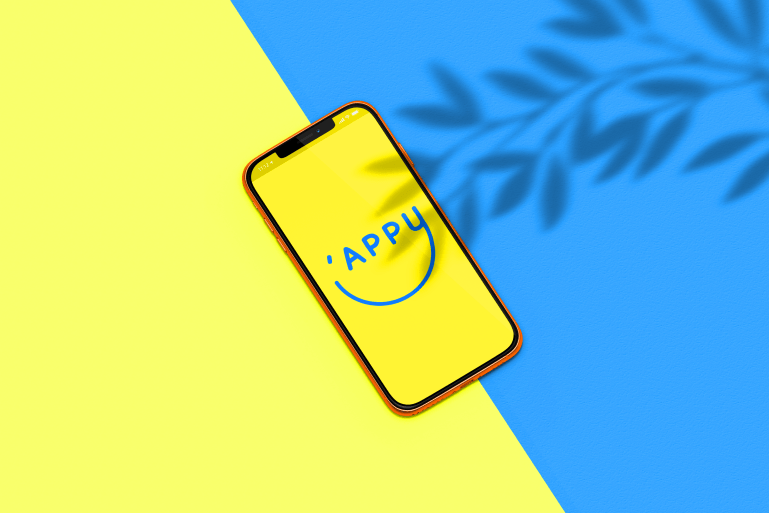
‘APPY is an app that is designed to do basically what it says on the tin, an app that will help you become happy. Due to the nature of the app I didn’t want it to be making any money from it’s users, so they’ll be no adds and no paid subscriptions – I’ll also be making a conscious effort to make the app as simplistic as possible to make the experience as stress free and easy to use as possible.

After having a look at several different lifestyle apps, such as Flo, Migraine Buddy and elements of Fabulous, I’ve managed to gather an overall feel for what works and what doesn’t visually. Then based from both personal use and opinions from my friends that have also used these apps I managed to work out which features would work for my product and which ones I could let go of, such as insights and chat rooms.
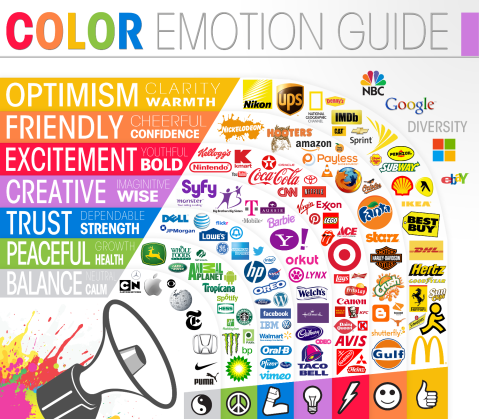
Based on the colour theory, I choose Yellow, Blue & Grey as my brand colours. Each of these colours represent a strong core emotion that I would like my app to mirror to it’s users; Optimism, Trust & Balance.
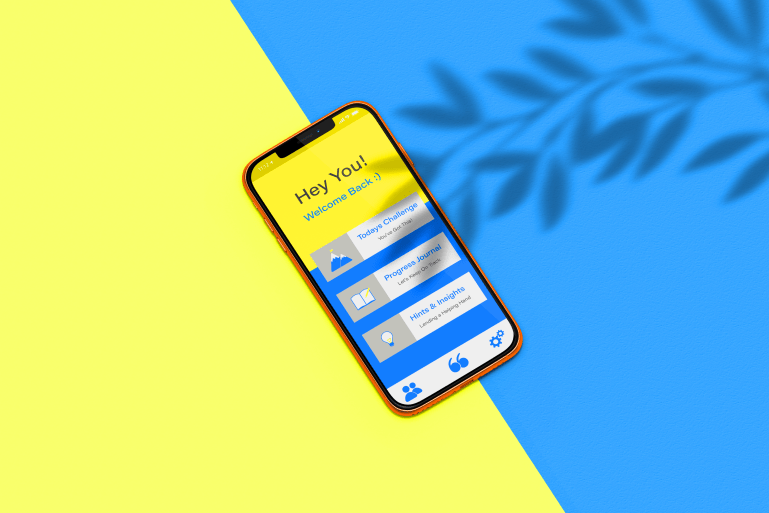
Using the brand colour palette I created the first draft of what I would imagine the apps home page to look like. I believe it creates a friendly, happy feel which would hopefully create a positive impact on the users leading to continuous use.


The features included in the app, alongside the core focus of the daily challenges include:
Progress Journal – here is a personal space that the user can use to log their past achievements and future goals. They’ll also just be a general note space for them to jot down any generic information about their day if they wish. I believe this would help personalise the app as well as create a motivational log for the user to look back on.
Hints & Insights – here they’ll be a vast range of information that relates back to the daily tasks. They’ll be articles they could read that provide helpful tips on how they could stay on track as well as personalised content that will be generated based on the users activities. For example, if there has been no achievements logged over a specific amount of time, the app may bring up information on how they can maintain focus and motivation. Alongside this they’ll just be general information that will be promoting helpful lifestyle information such as mental health, recipes and things to do in the users area.
Community Space – A space where users can interact and share their experiences as well as provide each other with support and tips on how they accomplish their challenges. Here they’ll be some conversational prompts from the app which the users can comment on and generate a thread of different conversations linking back to the original prompt.
Marketing
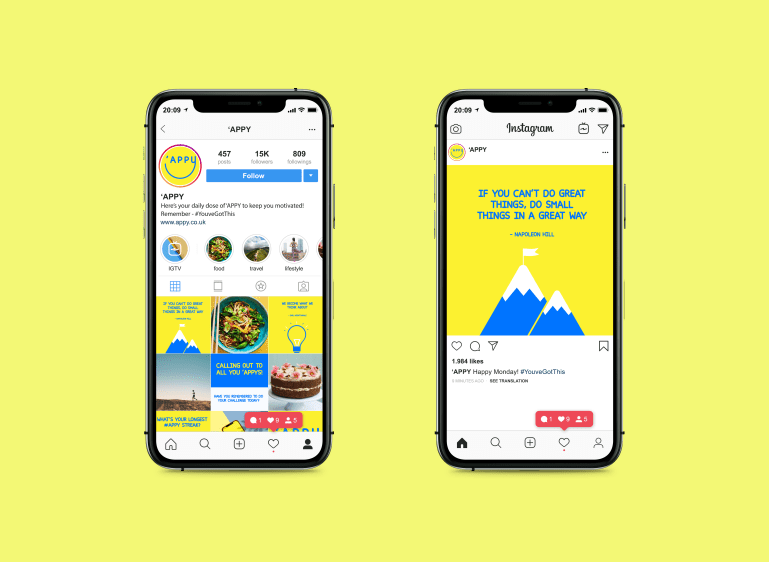
To get the word out about the app and what it can help people with, I really want to focus on Instagram to be the main social media base. Instagram is entirely image based which I think helps engage the users, especially when it’s content is specifically put in place to uplift those that see it and create a positive atmosphere. Through visualisations I have more of a chance of getting the branding out there, so in this case, the yellow and blue combination will eventually become associated with the app, making future marketing content much easier.


As the target audience is going to be ages around 18-30, it’s likely that they’ll respond to a social media platform before downloading the app to begin with. Instagram will allow me to share the content that will be within the app whilst gaining a substantial following – even if it’s only around 70% of this following that goes ahead and downloads the app, it will be a success as the Instagram will also have helpful information that will help it’s followers. After all, that’s all I really want from this app.
The content will mostly consist of the same information that can be found within the apps ‘insight’ area as well as motivational quotes and prompts to use the app.
Although this project has the potential to have a website as well, I think to begin with it would be wise to concentrate on the app and the social media presence first as they’ll be the main generators of users and communications.

Prototypes
Project Reflection
Overall, I’m extremely ‘appy with how this project came out, due to the simplistic nature of the app I don’t believe the mechanisms would be too hard to realise. This is a project I would like to come back to and develop further.
Although I’m content with the first draft of the home page design, I would like to revisit this to see if I could refine it a little more to give it a professional look – but saying that, perhaps this would lose the overall ‘friendly’ vibes that I had created.
Moving forwards, I would like to conduct a few more surveys to gather a clearer insight into the types of challenges people would want from this app. I’d also like to carry out some more work into figuring out how the app would communicate with its users, for example, a short quiz that the user is asked to complete upon registration which will allow the app to personalise the experience to each person.
I found the entire process enjoyable and it certainly fits in line with the type of work I would like to embed within my design career. I often find that a lot of my project circle back round to finding ways of which I could help people, more specifically with their mental health. Although this project isn’t a direct tool for those that struggle with their mental health it will certainly help those that use it maintain a healthy, happy mindset. As this is another not-for-profit design, it’s clear that I’ll have to apply for funding in some way to realise this app – however, I’m aware that this isn’t an area that I thrive in, due to this it’s likely that I’ll need to outsource some help to get me through this process. This is a skill that I certainly need to shape up on and become more confident in.
 Sian Laüra