Project – 365 Smiles
When looking back on the 10 potential projects I put up for discussion last week, I’m trying to focus on what could actually be achievable without it building up to a massive scale (as most of my projects tend to do)
I contemplated a few, but I believe the one that I think fit in with my design flow currently would be the Daily Challenge idea.
Daily Challenge
A book dedicated to provided the reader with a daily challenge to complete through the year. These challenges will focus on helping the reader break out of mundane routines and make each day different. The aim is to help people find happiness for themselves and others, it could also challenge them to try or learn something new.
This project would be based around generating a method to send encouraging daily challenges to the users for at least 1 year. When I was listening to Dan’s lecture, he brought up the question of what does the user actually want?

My immediate thought when coming up with this project idea was that the final outcome would be a book – but what if that wasn’t the best way to reach my audience? Which led on to the other question of – who is my audience?
After having a look at the Instagram’s of other people that have put something in place to bring joy or bring comfort to people in some way, their audiences are all pretty much the same. Females aged around 18-30. And although it would be nice to think that my idea would be open to all audiences, I think realistically this is the target audience I’ll actually be reaching.


My original idea was to get people trying something new or just out of the ordinary for them to try a bust the habit of sticking to one daily routine, boosting their mood. And by that, I don’t mean changing up the routine completely, because routines are healthy and there are many benefits that they can have on your mental health – but sticking to the same food groups, the same path to work every morning or the same outfits might leave you feeling like you’re just in auto-pilot mode, rather than living in the moment.
Saying that, some of these ‘challenges’ may be as simple as leaving someone a happy note, or starting a conversation with the person sitting next to you on the bus. They won’t all impact your day in a huge way, but they’ll aim to make you feel good.
Research
As my idea was still pretty broad in regards to how the challenges would be presented to the audience, the duration of the challenges and so on – I needed to create a survey to hear from people first hand.
Using Survey Monkey, I strung together a few questions that would help me narrow down and define my final outcome – I didn’t disclose what my project was to the audience as I didn’t want to create any bias that could have an effect on the results. As stated earlier, although I’m aware that this kind of project is likely to reach a younger audience, I would like this project to be available to all – I broadcasted this survey across my social platforms, inviting anyone and everyone to have their say.
Following Dan Parry’s advice, I tried to make sure that non of my questions were to open ended so I could gather direct and helpful data. The main focus of the survey was to try and find out:
a) If this is something that people would find useful
b) What outcome would suit them best
To keep answers simple and to the point, most of the questions could be answered with an equivalent of a ‘yes, no or maybe’.
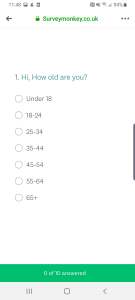
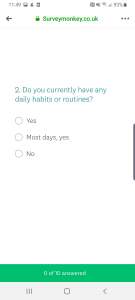
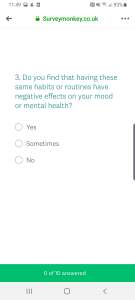
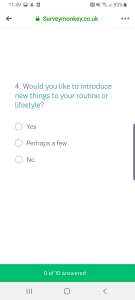
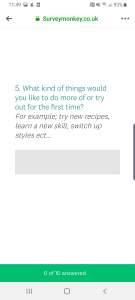
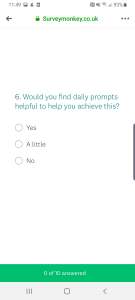
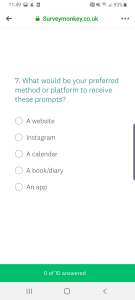
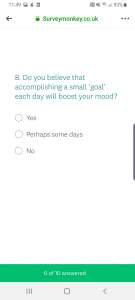
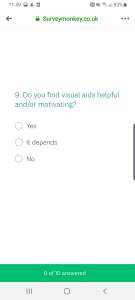
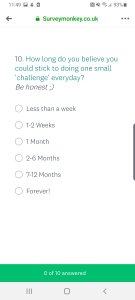
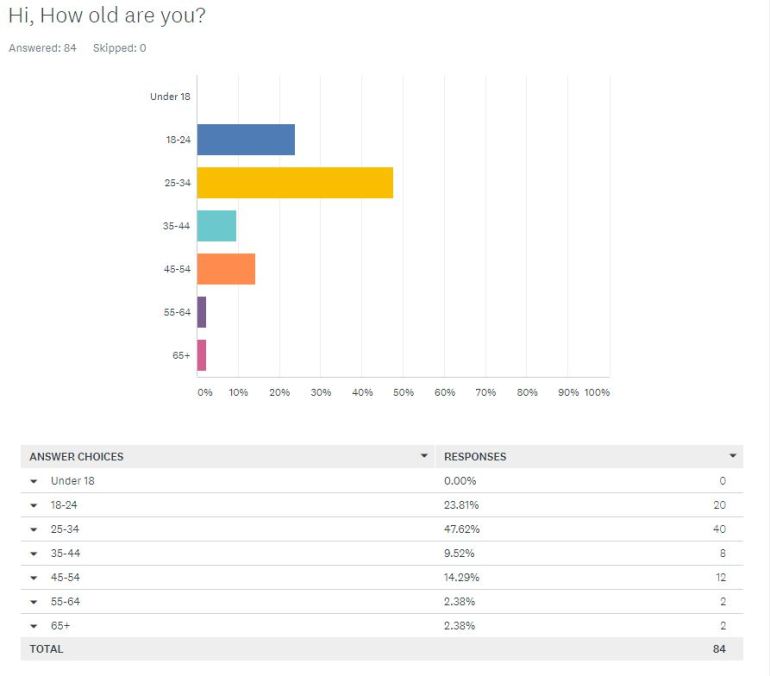
My survey gained a lot of attention leading me to gather 84 (and counting) individual responses. And although most people that filled out the survey were between the ages 18 – 34, I still managed to gather quite a lot of information from holder age groups, which really helps in making my project more rounded.


The 3 questions above all brought back a similar theme of answers – most people have a routine, and although that not necessarily always getting them down, they would find trying new things and accomplishing small goals could potentially boost their moods.

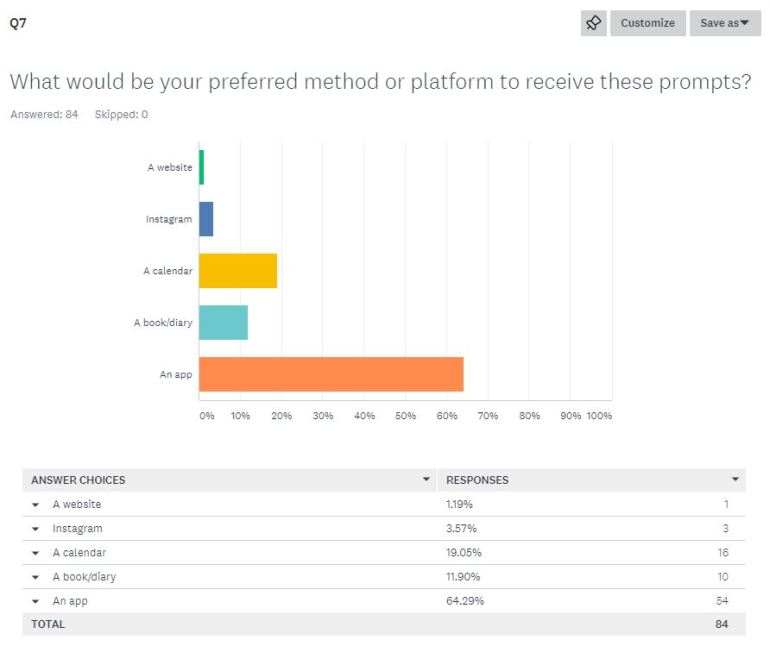
When it came to prompts, the answers were pretty varied, which implies that some people may find direct prompts more of a hindrance or an annoyance. It seems that most of the people would find an app the most useful way to communicate these challenges – an app, amongst many advantages, also provides with the ability to control the amount of notifications the app will deliver. This should help us manage the amount of prompts the audience receives, keeping the balance.
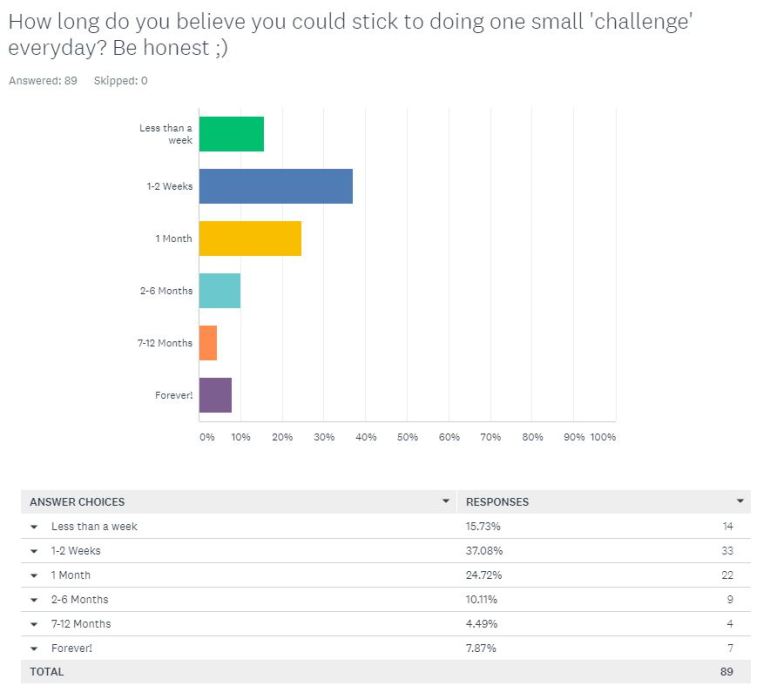
Originally I wanted my project to come in the form of a book, or a calendar and it was going to be set over a year, hence the initial title of 364 Smiles. However, the data I’ve collected clearly shows that people aren’t willing to dedicate themselves whole heartedly to it. They wanted an app, this already suggests they want to have something that isn’t final, an app appears to be more optional as you can download and delete them as you feel fit. This makes it easier to try out new things instead of dedicating yourself to purchasing and carrying around a physical book. In regards to how long the audience would be willing to take up something like this – that also seems to follow a similar theme. Although the majority of people have said they would only be able to keep it up for 6 months or less, there are still some people that seem ready to take on the challenge of having something to accomplish each day.
This makes me think that it would be best to move away from setting a strict timeline to the experience, and instead just making it available for people to pick up and put down as they please. Sure, they’ll be challenges that revolve around time, like ‘try to do one good deed each day for a week’ to keep the audience engaged but these won’t be too frequent. Most challenges will consist of just doing one small thing, this way the user can pick up the app and check off that they’ve accomplished something that day to serve as a small mood boost – or alternatively they can use it every day and embed it into their lifestyle. The control is completely in their hands, the app will just be a pleasant option if they wish to use it.
Design
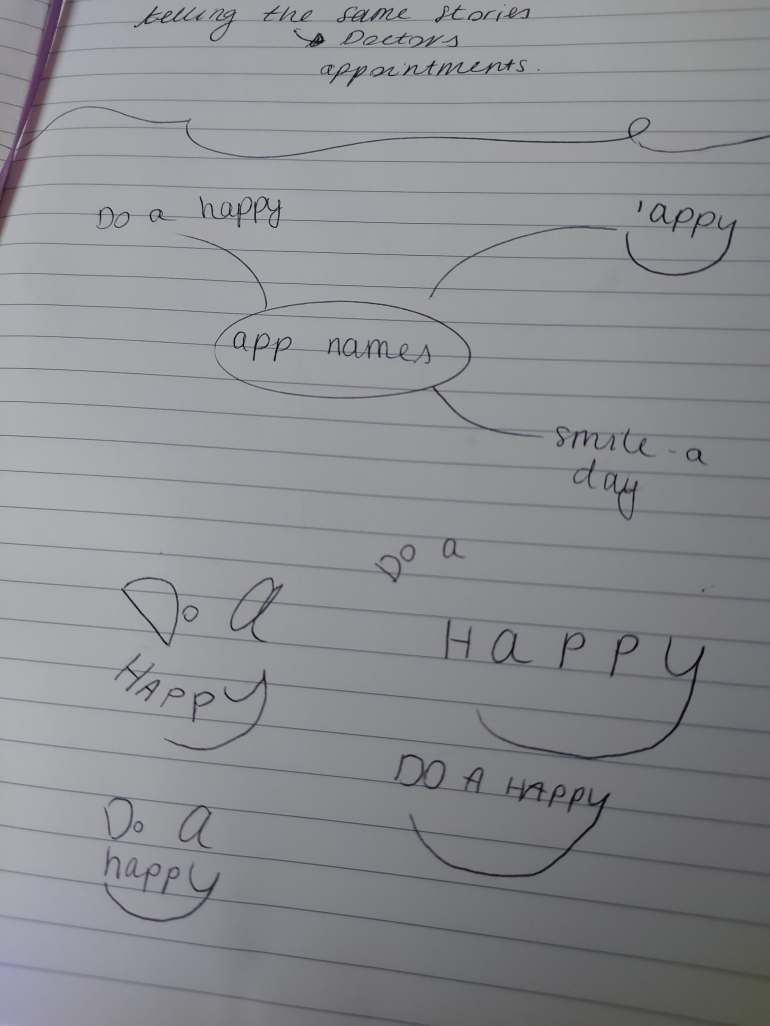
This did mean I had to come up with a new name for the app – most apps on the apple store or playstore are usually have a simplistic design that gives the browser and instant insight into what they have to offer. Going along with this theme I came up with ‘APPY, it’s short, simple, let you know it’s there to make you smile in one way or another and better yet, when said out loud it gives you a taste of the Yorkshire accent.
After trying out a few colour that would provoke a happy response (using guidance from the colour theory) I decided I like the two yellow versions the best. I put it up to the vote of a few of my friends and we came to the decision that the yellow and blue combination was the one to go with, talk about professional testing.


On a serious note though, I’m happy this was the preferred colour combination as there’s something a little too grounding about the black, the blue makes it seem a lot more approachable and following on from the below colour theory emotion graph, it clearer is a trustworthy colour amongst brands.

Research links:
https://www.entrepreneur.com/article/228328
https://www.hswsolutions.com/services/mobile-web-development/mobile-website-vs-apps/
https://thinkmobiles.com/blog/how-do-free-apps-make-money/
Finance
Financially, I won’t be able to support the project myself once it gets to the stage of producing the app. All the graphics and content for the app will be made in house, however as I don’t currently hold any code or app making skills, I will have to outsource someone to help me realise the app itself.
Ideally, I would like to work with a smaller business or freelance coder as this would be more in line with the project’s ethos. This could also mean that the cost of the production is minimised. As there’s no real time constraint on when the app is to be built, there would be no reason for me to go with a larger firm.
For funding, I would hope to receive support from charities such as Mind as the project is indirectly linked with helping people’s mental health, this alongside Crowdfunding would provide me with a stable income to make sure the project moves forward. Another possible route is to apply for funding through grant schemes put in place by several councils and businesses, however, to do this I need to make sure my product fits in line with what they choose to fund. As there are multiple different places that offer these kinds of schemes, I just have to make sure I approach the right audience, for example, The Arts Council may find this project something they would be keen to invest in. Although this route may take a little more time, it seems the less risk adverse as I won’t be particularly relying on crowdfunding and it’ll also give me the options to receive a larger sum of money to put into developing the app.
When it comes to business plans and funding applications – in honesty I’m not entirely comfortable with creating them so whilst I was going through this process I would like to receive support, whether that be paid or not.


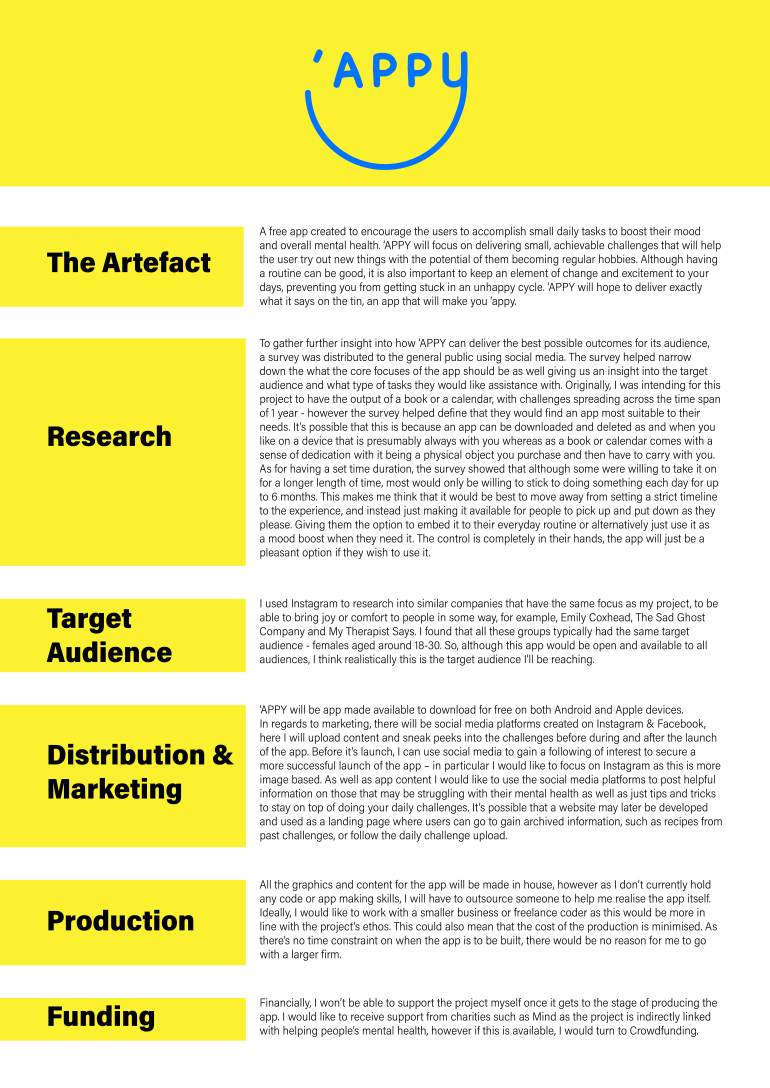
Project Overview
 Sian Laüra