What is Intellectual Property?
Intellectual property (IP) refers to creations of the mind, such as inventions; literary and artistic works; designs; and symbols, names and images used in commerce.
IP is protected in law by, for example, patents, copyright and trademarks, which enable people to earn recognition or financial benefit from what they invent or create. By striking the right balance between the interests of innovators and the wider public interest, the IP system aims to foster an environment in which creativity and innovation can flourish.
Thanks, WIPO.

This weeks lecture really opened my eyes to the realities behind a lot of the commonly seen designs out there. Although some parts gave me a huge feeling of security, it was actually quite daunting to learn all the complications that could be hidden within a contract, that if not spotted, could trip you up in the long run. All it takes is for one indemnity to stop you in your tracks.
However, it was really interesting to learn about the ins and outs of how the law works to protect intellectual property, and it was nice to find out that most laws in place are actually put in place to help protect the creative – however in some cases these will only work as long as you also have a heavy pocket to bring them to action.
One of the main takeaways from this is just how important it is to keep records and proof of your work process – this alone could be what decides your designs fate should it ever be put under the eyes of the law. In these cases, it may also be worthwhile keeping these dated too. It’s good to keep this in mind as you begin to have ideas, IP protection does not cover ideas so if someone was to catch wind of your plans and start creating it first, unfortunately you would have a leg to stand on in terms of claims. You must have it down physically for it to become protected.
This goes to show that although it is still smart to be careful what or rather how much you share online, small creators shouldn’t have too much worry when sharing their creations through an online platform. By sharing your work through a public domain you are putting that idea to your own name, so should anyone try to copy it, you would be covered under the IP protection and copyright act. Hooray!
Pepsi Schein
I came across Henry Schein’s logo whilst searching for possible cases of copyright infringement, their logo is unmistakably similar to another well known logo.. So much so I can barely believe there hasn’t been a case about it yet.


If you haven’t already guessed, I’m referring to the Pepsi logo. Both these two logos have the same two primary colours as the base with a white wave parting them. The only true differences between two is that Henry Schein have tilted the original logo and cropped it into a square rather than a circle. After further investigation I noticed that they had also slightly changed the tint of the red & the blue too, however I don’t see this as a huge differentiation. Although this Pepsi logo is no longer in use, Henry Schein revealed their logo around the 1980’s so the two logos had definitely overlapped for decent duration of time.
Copyright protection act states that it prevents people from:
- copying your work
- distributing copies of it, whether free of charge or for sale
- renting or lending copies of your work
- performing, showing or playing your work in public
- making an adaptation of your work
- putting it on the internet
So doesn’t this mean that Henry Schein’s logo is in fact just an adaption of Pepsi’s? Therefore, isn’t this infringement?
To demonstrate just how closely linked the two are, I’ve put together a (very) short demonstration on what few steps were put into place to transform the Pepsi logo into Henry Schein’s.

For the sake of experimentation I decided to trial out recreating a new set of logos, using the Pepsi logo as the base. I wonder if I was to release any of the below logo’s, if these would be vulnerable to legal action from either Henry Schein or Pepsi now? How many changes would it take for me to be deemed safe or is the value of the wave between the two colours too high to be compromised, no matter how many changes were made?
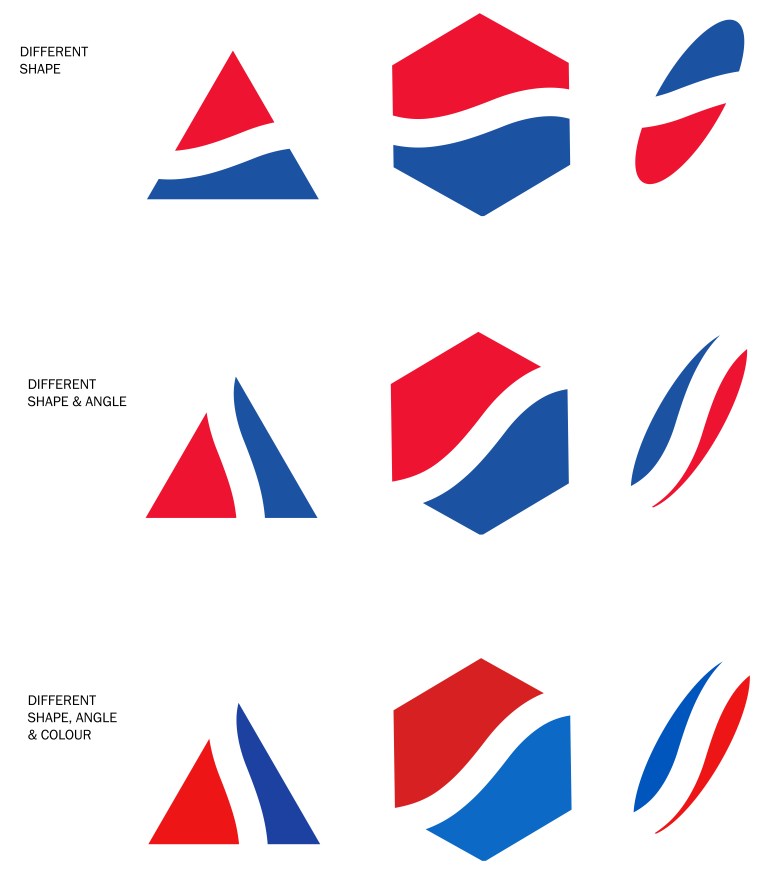
Although it’s difficult to claim copyright over a colour combination, I do believe that Pepsi would of had a strong case for claiming copyright to the white wave in between the red and blue. That’s their identity, you can’t not see a white wave between any two colour and think of Pepsi.
We’ve recently watched as Tokyo’s Olympics logo was scrapped after allegations of plagiarism. And although you can see that the logo’s have a few differences, the similarities between the two undeniable and you can understand the Theatre’s uproar. If there can be a winning case on these grounds I find it hard to believe that if Pepsi were to take Henry Schein to court for plagiarism they’d be turned down.

 Sian Laüra