The Idea
This week my focus is to finalise the article text that was formulated last week and find a way to bring both text and design together into one holistic design.
As the primary base of my text is how photo manipulation can be used to create illusions, I knew I wanted to bring an obvious example of this through into the design. I originally played with the idea of using coloured film to accomplish this – as it has the ability to reveal two different narratives within the same photograph.
Similarly to Sagmeister’s ‘Made You Look’ book – I had been planning on using this effect within the design of the front cover. To see what was possible using this process I created a GIF that reveals two different emotions when a rose layer is placed over the image.
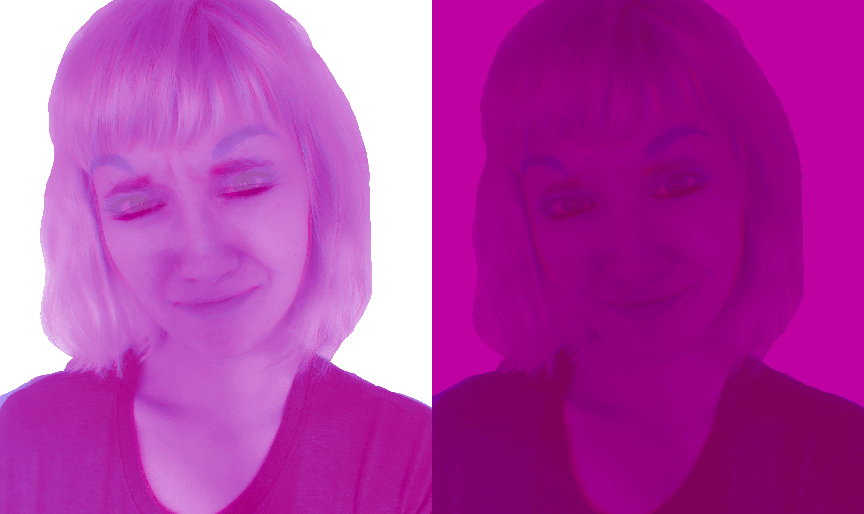
Through incorporating this type of design I would be able to create a literal take on the idea of how social media allows us to perceive the world through ‘rose tinted glasses’.
Another idea I had was to incorporate QR codes within my design as this would allow me to somewhat subtly include information or photographs – I believe this was a good way to mimic how we use social medias as we try to keep non-desirable elements of our lives ‘hidden’ whilst showcasing the success.
Research


I came across a few images that highlighted how easy it is to create ideal narratives through photo manipulation. I thought this was really interesting, especially as it was such a simple method creating such a great impact.
This got me thinking about how I could represent the images within the article – I could potentially mimic the traits of social media imagery and create a way to reveal the real image alongside it as an example of the effects of everyday photo manipulation.

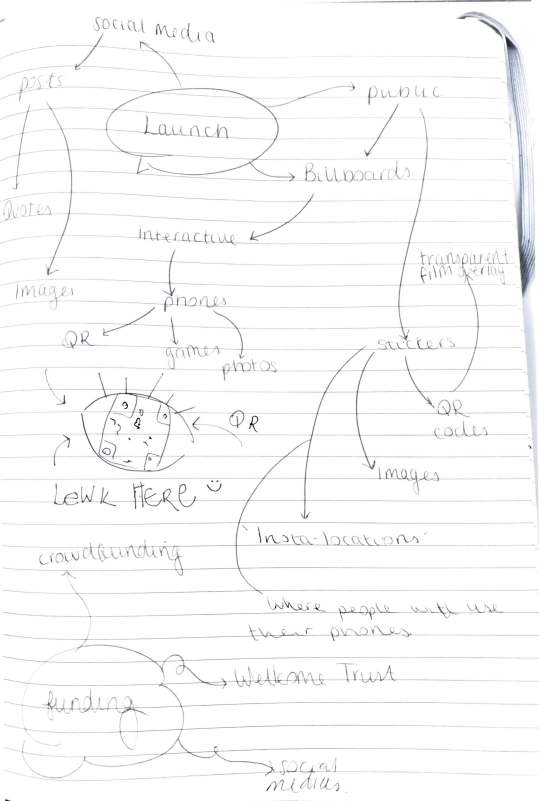
As the article tries to tackle a social issue, it only seemed fitting to plan for the launch to continue this theme. I came across a few of McDonald’s previous campaigns where they used interactive billboards to directly involve their customers. Through a combination of games and puzzles, McDonalds successfully managed to create attention to their products as well as create a relatable persona, thus inviting more customers to their restaurants to consume their products.
I thought this would be an excellent method to promote the launch of my article as it would almost force engagement from the get go.
Process


For the images, I wanted to use typical ‘Instagram-able’ items. Such as; gifts, flowers, shoes, pets, food, selfies, location & clothes.
Food was the most accessible, so this is where I began. I was particularly pleased with the fortune cookie, as this combined both food and cheesy quotes, social medias top picks. The back drop for each of these was chosen to carry out the theme of ‘rose tinted glasses’, however after shooting I found that it also worked to create a very ‘in your face’ fake vibe, which was rather fitting for the text.
For each item I captured ‘social media acceptable’ images to use within the article which I would then contrast with a photo from afar, revealing the mess around the objects.


It was at this point I decided that using a QR code rather than the film would potentially work better as it would create more of an immersive feel as it would take the audience away from the original image to see the ‘reveal’. I decided to make the QR code replicate an eye as a metaphor for becoming aware of the truth, it also creates the illusion that it is watching you. It’s pretty direct but I still feel it gives the audience the choice of seeing it as either a friend or an enemy.


For the cover, to continue with the colour theme and nod towards the ‘rose tinted glasses’ reference, it only made sense to have a photograph of roses.

After presenting my first draft to Stuart, we discussed the possibilities of using two contrasting fonts throughout the design to further the idea of the contrasting realities we are being presented with on a daily basis.
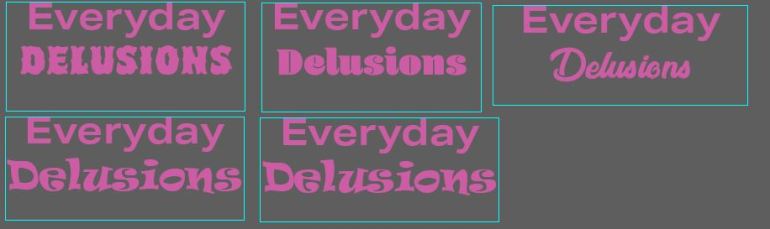
After trialling out a few different typefaces and applying this change to the front cover, I’m actually really pleased with this. After applying this change and cleaning up the roses a little more, I feel it has a more sticking overall effect. You can see this, as well as the other pages created this week in the PDF below.

Everyday Delusions
Although we tend to know the truth amongst manipulated images, whether it be a Snapchat filter or a manipulated body on a magazine cover, it’s still difficult to keep these perceptions separated from reality. As we edge closer into a digitalised world, we’re beginning to lose control of what content we see daily, leaving us vulnerable to deception. We all know models are photoshopped, most of us know that food industry posters don’t really contain any real food at all – but what about photos we manipulate for ourselves?
I’m not talking about the ‘tech-savvy genius’ out there who are able to create entirely new worlds using photoshop. I’m talking about every-day manipulation. The photo you posted of your dog’s OOTD on Instagram this morning, the coffee cup photos you posted alongside the caption ‘Mondays’ on your Facebook feed. What impact are these ‘projections’ of perfect lives having on society and on us as individuals? To start with, I’d like to revisit a classic example that puts into perspective the power of photo manipulation.
Back in 1917, two cousins set off down to the beck placed at the bottom of their garden with the intent to produce two photographs to show to their family – little did they know, that these would completely change their world as they knew it. For reasons still disputed to this day, Frances (10) and Elsie (16) had produced a plan to capture photographs of themselves posed amongst ‘fairies’ – to put the plan in motion they used Elsie’s fathers `Midg’ camera, some hairpins and hand-illustrated paper cut-outs and set off down to the beck. And thus, the story of The Cottingley Fairies began.
The two original photographs the girls took of themselves alongside fairies cut outs weren’t taken seriously by their family and were put to one side – remaining dormant within the household for two years before they would eventually come to surface. During these years, Polly, Elsie’s mother had begun becoming more involved with the idea of Spiritualism. It wasn’t until she attended one of the Theosophical Society meetings that she began believing in the concept that these images were authentic, this hope led her to present the girls’ photographs to the public. Around this time, the movement of Spiritualism had risen as people had become somewhat reliant on it to make sense of a generation that had been lost during the First World War. It was a belief and to some, a lifestyle that presented people with hope and sanity as it provided them with a potential method to connect with their lost loved ones.
The leading member of the society and a prominent advocate of the supernatural, Edward Gardner took an immediate interest in the photographs and began to explore the possibilities of their authenticity. He carried the photographs with him to meetings and held them up as a topic for discussion. Following this, he presented them to a photographic expert, Harold Snelling, who after checking for signs of manipulation within the dark room, stated that the photographs were authentic. It was from here, that the concept of fairy existence began to rapidly escalate, feasting upon the already growing movement of spiritualism. Arthur Conan Doyle, the author of the Sherlock Holmes books, had recently lost his son during the last weeks of the war. It was since then that the author had become involved in attempting to prove that there was, in fact, a connection to be had with the dead – and so began his journey with Spiritualism.
The photographs had caught the authors attention and after a few meetings with Dr Gardiner, he decided that the most logical way to settle the dispute of whether they were authentic was to ask for the girls to produce more photographs. They provided the girls with a quarter-plate ‘Cameo’ camera which had marked plates within them to detect any kind of manipulation. The girls then promptly did as they were asked and produced 3 more photographs that captured themselves alongside the ‘fairies’ – once again these were proven to be authentic as the actual manipulation was done by placing the cut-outs in frame beforehand rather than in the darkroom afterwards. Doyle enthusiastically wrote up their findings in an article for The Strand magazine that spoke of the existence of fairies using the girls 5 photographs as proof. Although he did his best to conceal the identities of Frances and Elsie, once the article was published it quickly got traced back to them. This led to swarms of people making their way to their home in attempts to witness the fairies first hand, forcing the girls to go into hiding.
It’s never been clear as to why, perhaps from embarrassment, sympathy for those that believed or even self-delusion, but the girls chose to keep their secret of manipulation from the world for around 65 years – before eventually owning up to the fact that it was a hoax all along.
It doesn’t take a genius to be able to take advantage of photo manipulations uses. Which goes to show in this case, as two young girls, with little to no experience using a camera, wanted to create some photographs to play on the idea of fairies’ existence – and through photo manipulation, they managed to successfully share this illusion with the world.
However, photo manipulation hasn’t always been quite so far-fetched as the Cottingley Fairies, and there are many cases where it’s use wasn’t communicated in order to maintain the delusion it was creating. In fact, many iconic snaps have been manipulated through airbrushing techniques to satisfy governments and dictators. For example, in 1939, Canadian Prime Minister William Lyon Mackenzie King had a photograph of himself posing with Queen Elizabeth and King George VI edited in order to remove George entirely from the photograph. As this was later used on an election poster to promote William, the theory is that he had this done to give off the illusion of power as he stood alone alongside the Queen of England. Alongside creating political viewpoints, photo manipulation was also used by the media to create and present new impressions, perspectives and eventually beauty standards to the public eye. In 1989, the TV Guide created the infamous front cover showing Oprah Winfrey proudly posing on top of a pile of money. Except, it wasn’t Oprah Winfrey at all, it was only her head placed upon the top of, 60s star, Ann-Margaret’s body. Shockingly, the magazine hadn’t thought to seek permission from either of the women before manipulating both of their bodies and publishing this on their front cover – and if it wasn’t for Ann-Margret’s fashion designer who recognised the dress, the world would have been none the wiser.
Since then, the trend of using photo manipulation to mould beauty standards has progressed and is consistently used to edit out ‘flaws’ of celebrities and models before being printed or posted online. Although it has reached the point that we’re not only aware of its use, it is almost expected, as it’s all done behind closed doors it is always still shocking to see just how much a photograph is edited and taken away from the original – in some cases, it’s almost unworldly. Throughout the years there have been several photo leaks that have revealed the originals photos next to the ‘official’ ones that had been used, resulting in outrage from both the public and the people within the photographs – causing them to speak out about how its’ use is forcing unrealistic beauty standards out into the world, leading to anxiety and self-esteem issues within the public. Unfortunately, regardless of how we actually feel about photo manipulation, it has still managed to become part of our every-day life, so much so that we now feel the need to edit our own photographs before we deem them ‘acceptable’ to post online.
Most of us either use or have had experience with social media in today’s world. Since the beginnings of Facebook back in 2004, social media channels have slowly but surely made a strong status for themselves within our day to day lives. Although most are quick to tell the tale that social media was originally created to bring people together and establish close, meaningful relationships – its origins are somewhat astray from this path. In 2003, whilst still studying at Harvard, Mark Zuckerberg amongst other students created an online programme called “Facemash”. This allowed users to objectify fellow students by comparing photos of their faces and selecting who they deemed as “hotter”. Understandably, this idea was quickly put to a halt when Harvard’s Administration team disapproved of this and demanded that it was to be shut down.
With this in mind, it’s difficult to believe Zuckerberg’s stated agenda of ‘bringing people together’ when he later went on to produce Facebook, seeing as his first social media channel was simply put in place as a means to judge people from afar and normalise the process of putting people into a hierarchy based on appearances.
Since then, social media has continuously evolved and snowballed, picking up millions of users along the way. In 2010, Instagram was developed and was one of the first social medias to use photographs as the primary means of communication. Instagram’s launch proved to be a roaring success as the app managed to accumulate 100,000 users within its first week. Although smartphone photography was becoming more popular, the quality of the cameras within the phones weren’t the best, and allegedly, it was for this reason that Instagram incorporated its built-in filters and editing tools. As the app became more popular, so did the process of editing photos. Photographs became more staged, from regular selfie updates to photographs of what you last ate, everything was carefully set up and edited to produce a more ‘visually appealing’ image to post online. It’s now got to the point where you can quite easily find 100’s of articles and guidelines that will provide you with a step by step process on how to edit your photo’s ‘like a pro’, so you can rest assured, your followers will see a perfectly put together image on your social media that day.
A year later, Snapchat (previously known as Picaboo) was launched. This was yet another social media channel that focused on the idea of communication through photographs, but instead of it being a place to post and keep your images online, it was a messaging app that allowed its users to send photo, video, and text messages that would disappear after several seconds. The apps ‘disappearance act’ feature certainly commissioned a few brows-raises, and although the creators stated that the reasoning for this was simply to create a new way to share awkward selfies and funny photos with their friends – it’s hard to ignore the possibility that ‘private matters’, such as sexting, were highly considered during the creation process. The app’s success skyrocketed after it’s release of filters in January 2015 – these filters allowed for users to completely change and/or edit their faces to photograph and share online.
Although these filters started reasonably light-hearted and fun, for example; having a filter that created huge eyes and a rainbow coming out of your mouth, over time they have begun to lean towards creating filters that focus on ‘beautify-ing’ their users’ faces. Each of these ‘beauty’ filters primarily consist of the same effects; bigger eyes, paler skin along with a thinner nose and jawline. As these filters are all automatic, once used it removes the opportunity for their users to customise which parts of the filters they’d like to take or leave, enforcing the idea that whoever is using them must accept all of these changes to become their visualisation of what is ‘beautiful’.
The Instagram filters work almost instantaneously, making it hard for users to see just how much the app has edited their faces. They can switch between a wide variety of different versions of themselves within seconds, making it hard to establish what they actually look like and what is being digitally created. This, as sad as it sounds, has been known to lead to feelings of disappointment and lower self-esteem when they eventually remove the filters to see their actual face. It’s unfortunate to see that these feelings have then progressed and began to manifest within most selfies that you’ll see today – manipulated selfies and group photographs are becoming the norm to the point where people are hardly recognisable in real life due to their online appearance being so heavily edited. That being said, there are people that have decided to take this a step even further.
Cosmetic surgeons have created the term ‘Snapchat dysmorphia’ due to a steady increase of customers that have approached them and outright stated that they wanted to adjust themselves to look like their manipulated photos. The numbers aren’t the only things that have changed either – the types of requests are evolving too. According to The Independent, a survey found that 55% of plastic surgeons last year reported seeing patients who wanted to improve their appearance in selfies rather than reality. Although this is an obvious case for concern as it sheds a spotlight on the new lows of our society’s self-esteem, it also raises the question of whether we’ve completely began to lose touch with reality. As Snapchat filters have no real bounds or limits, their filters can completely bend the rules of reality to create an aesthetic based on fictional desires – creating new, unobtainable beauty standards. With this being the case, one can only assume that those choosing to undergo surgery in attempts to achieve this look will be led down a continuous path of disappointment and low self-esteem.
Whether it be photos of ourselves or of our surroundings, we seem to be consistently striving for something more than the reality of what it is. We take photos of ourselves at events to be able to show others that we’ve been there rather than just be there. We stop and take time to position and document the food we eat, the clothes we wear and the places we go to show, rather than choosing to live in the moment and enjoy them. This kind of behaviour is arguably caused by the increasing fear of missing out, it’s just ironic that as we stop our lives to document such things, we’re missing out on the natural enjoyment of life. As we dive headfirst down this rabbit hole to chase these unrealistic goals and expectations, we, in turn, leave ourselves vulnerable to developing mental illnesses such as anxiety, depression and body dysmorphic disorders. RSPH and the Young Health Movement (YHM) published a report in 2017 studying the effects that social media has been having on young people’s health. As an introduction, they stated “Rates of anxiety and depression in young people have risen 70% in the past 25 years. Our own research has shown that young people themselves say four of the five most used social media platforms actually make their feelings of anxiety worse”. And after studying the top five social media’s (Facebook, Twitter, YouTube, Instagram & Snapchat), they found YouTube to be the only social media that showed to be having a positive impact, whilst the image centralised apps, Instagram and Snapchat, came out as the most detrimental to young people’s mental health and wellbeing. Regrettably, it doesn’t stop there. A paper that was published by the Clinical Psychological Science tragically found that between 2010 and 2015, teen suicide attempts have increased by 23% and the number of 13 to 18-year-olds who committed suicide have leapt up to 31%.
Although I do believe that the strong contributing factors to these changes are the everyday delusions that we are continuously being exposed to, it’s hard to put the entire blame on the use of photo manipulation within social media, when we’re the ones that are actively feeding it. We’re aware of the damage photo manipulation can cause, yet we discredit this when we continue to use it every day.
Taking this back to the Cottingley Fairies, we saw how using just two photographs, Frances and Elsie gaslighted an entire religious movement to rise as they managed to persuade thousands of people to reconsider their beliefs on the existence of fairies. And although their methods were dated, they still achieved all this using the same processes as we would today when posting a photograph up onto social media. They prepared their photograph, which was, in this case, the creation of the cut-outs, opposed to us now finding an ‘Instagram-able’ backdrop or the best lighting. They then manipulated the photos with the positioning of the cut-outs and created the photograph using Elsie’s father’s camera, just as we would using filters and/or apps on our smartphones. Then their images were released to the public resulting in followers and reactions from their viewers.
With this direct comparison, we can see that the Cottingley Fairies hoax wasn’t so dissimilar to everyday photo manipulation we use now – and we’ve seen just how much of an impact that one case of manipulation had on their society. So then, why do we deem it acceptable to do this to ourselves repeatedly now without for a second considering the impacts it is having? Why are we choosing to let it lead us, so seemingly, blind?
They say ignorance is bliss, but we are not ignorant. We can no longer choose to sit with metaphorical hands over our ears and eyes, it’s time that we come to terms with the reality of the dystopian prospects we are building – and make active changes to avoid this.
You may still be reading this, believing that such stories are only cases of the extremes. But just because you’re not hearing them, that doesn’t mean they’re not happening. Each time we post a manipulated photo of ourselves or our lives online, we are adding to the creation of a delusional, digital world – leading to the increase of mental health and ultimately, suicide rates.
Now I’m not by any means suggesting that we’re to suddenly stop using social media, but I’d like to challenge you to try and change your perspective on it, just a little. Next time you’re preparing to share a photo with the world, I’d like you to stop and think.
Do I really need a filter on that?
 Sian Laüra