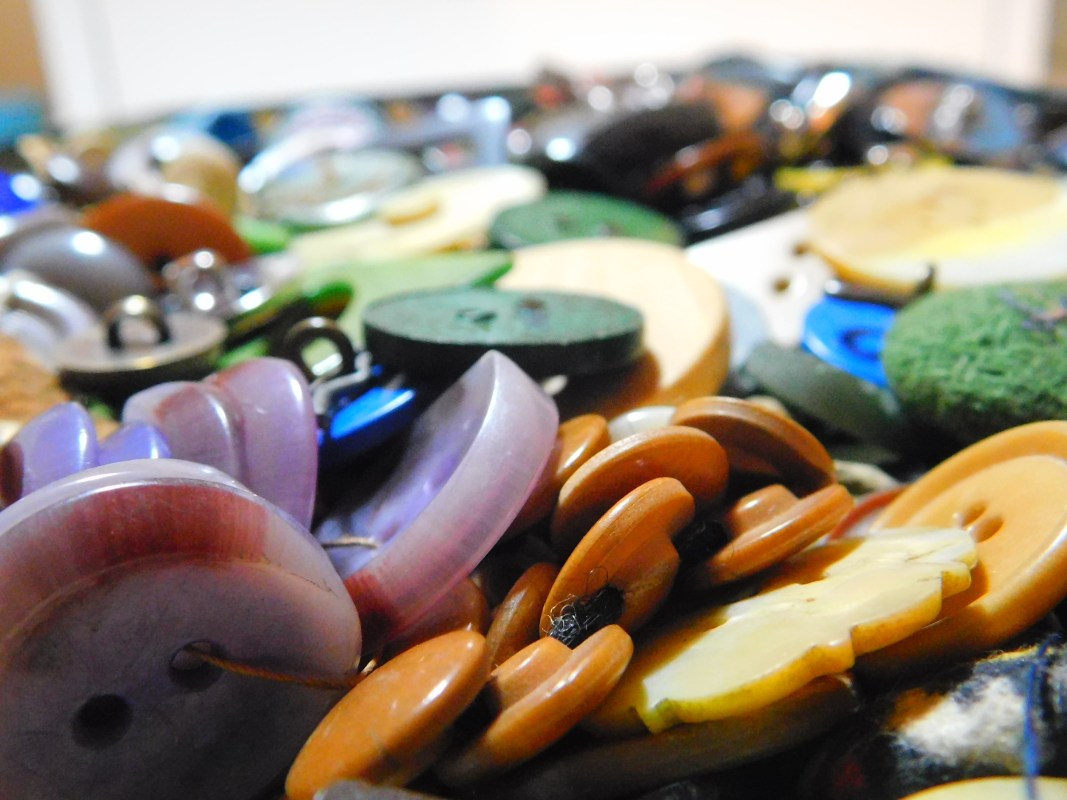
Sensibilities
During this weeks lecture Susanna & Maziar brought up the conversation of sensibilities. They proposed that we all consider our own and reflect on how they effect our practice. This got me thinking and as I looked around my room I began to notice what I had chosen to occupy my immediate surroundings. It seems that I like to collect materials, tools and well… just ‘stuff’ that I believe could be re-used/re-cycled again in some way or another.


Looking at what I have I can’t usually remember picking these things up or purchasing them with an intent in mind. In fact, most of them I can’t remember how they came into my possession in the first place. This usually leads to them being placed around my household for a number of years before I even consider an actually use for them, or sometimes I just don’t. This implies that it perhaps as a subconscious thing, I see a use in it. Not sure why or what, but I do. So I pick it up. Usually, most the things I collect are put out on display to remind me of them, this is usually in hopes that they’ll spark a new idea – but even if this isn’t successful, they can act as a nice piece of ‘decoration’ in the meantime.

After realising this, I strongly believe this reflects on my everyday practice, especially my final outcomes over the past several weeks. I have a desire to create new objects/uses out of everyday things – I seem to consistently want to create using what I already know, I find it really exciting when I can find a new use or perspective on an object or tool. I can actually recall that one of my favourite past time when I was in primary school was creating little figures of ‘people’ using twigs and leaves. So this isn’t something new – but it’s certainly just as exciting as it was then.
So as for my sensibilities in design – it seems I’ve been subconsciously collecting an archive of my own all these years, and I’m going to be giving this some attention this week.
Change Within Design
This weeks case studies proposed two questions to a variety of established designers on the subject of change withing design. The first question was, “what are potential future definitions of design practice” and the second, “what are the sectors that might change or need to change?”.
After listening to all the answers from both videos, it seemed that there was really two key factors that had an impact on both questions.
- Technology & the changes it has thrusted upon us
- Having a multifaceted approach to design
In most cases, technology has provided us with positive changes that have benefited our lifestyles and well being. However – we can’t ignore the fact it’s also factored into changes that could be perceived to be having negative impacts within our social behaviours as well as design practices. Sam Winston spoke about how we’re currently living in an Attention Economy, where attention and time are highly valued as it’s currently so in demand.
After looking into this a little more in depth, I came across a really interesting video that summarises the attention economy brilliantly, in my opinion.
Although it’s a topic that is becoming more commonly spoken about, it still shocks me to see facts and figures on how often we use technology for distraction alone, both consciously and subconsciously. However, it really puts into perspective the responsibilities that anyone has when they choose to put a form of media out into the public eye, or as phrased in this video the ‘Attention Engineers’. Whether that be a Facebook social media post stating your political opinions, a Youtube tutorial video on applying make-up or a visual design portraying the importance of speaking up about mental health. Each and every one has information that will undoubtedly be consumed by their audience.
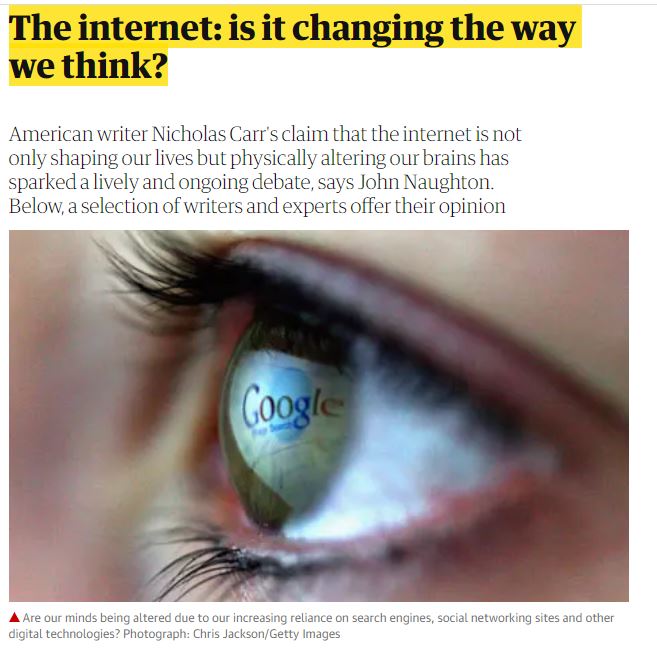
Kris from Regular Practice shared an article with us during last weeks webinar (link to full article here) that discusses the potential impact the usage of technologies and the internet is having on our brains. I found this extremely interesting and I believe it’s a topic that needs to be made more aware, or perhaps be taken more seriously than we have been up to this point. I think it’s safe to say that everyone can admit to a time where they’ve picked up there phone to send a text or check the time and found themselves being completely distracted by something else, perhaps a social media notification, and placed the phone back down without accomplishing what they originally wanted. Our attention spans are become shorter and shorter due to the majority of today’s content being shortened down into easy, digestible information – we’ve overloaded ourselves with limitless information which ironically seems to be limiting us even more. It’s not taken long to get to this point – so I dare to wonder what will become of us 10 years down the line?
In a sense this ties in with the second main point that was spoken about during these videos. Multi-tasking. Our social behaviours seem to be merging with our working behaviours – we no longer seem to have defined roles. More and more business are creating roles that cover a wide variety of tasks. For examples – my current role requires me to be a graphic designer, a marketing strategist , a sales rep and at times, a product specialist. Most of the time this is due to a lack of budget within the business to hire more staff, however this can also be due to people simply not wanting to be limited to one area within the business. And I understand that to a point, however I do find that by stretching people out so thin, you’re opening the potential for larger skills gaps. If we continue forcing people to cover such large areas of business and practice – surely we’re losing out on huge areas of knowledge? No-one will any longer be a specialist in a specific area, this will impact sole designs as well as collaborative ones. By capping yourself to only learn so much about a method or a tool, you’re losing the opportunity to explore and see new perspectives which could lead to only generic designs and ideas being created.
As much as I believe having a multifaceted approach to design is important – I think that forcing upon yourself or others will lead to a watered down version of possibilities.
The Idea
Recently, my Grandma passed onto me a box full to the brim of a variety of buttons. They originally belonged to one of her close friends who made a habit of collecting buttons, solely on the basis of ‘what if’s’.
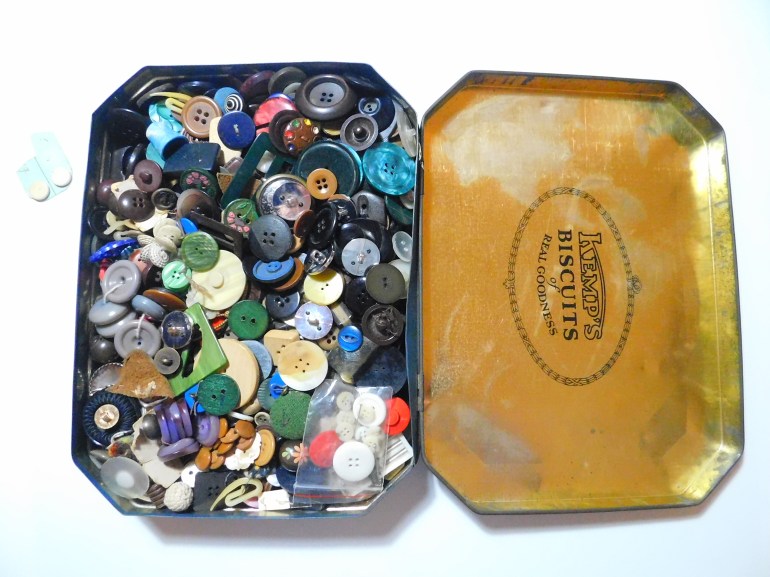
I can only assume by the tin they were kept in, that she had been collecting buttons for most of her adult life. The Kemps tin that it’s kept in looks like it could be from around 1950’s, although it obviously has signs of general wear and tear, I’m actually amazed at the condition of the tin itself. The original print, although somewhat eroded, still shows on the front proudly. I can only wonder what the original colours were like.


Even though the tin itself holds it’s own kind of beauty, nothing quite compares to it’s contents. Such a range of buttons in all shapes, sizes, colours and textures. There were even a decent amount of full sets, some of which had been very delicately tied together with fine string, creating some lovely shapes in the process.


It was clear that the collector of these buttons was determined to put these to use in one way or another.
I began looking into ways I could potentially put these to use, during my research I came across a number of designers who use either or a combination of buttons and wire to create sculptures.
Augusto Esquivel
“I repeatedly thread thousands of these buttons using clear monofilament, to “web” three-dimensional objects into life.”
I love how Augusto captures the simple, fun elements of the button through his work – by uing primarily primary colours he brings a real nostalgic and happy feeling to his designs.
http://www.augustoesquivel.com


Ran Hwang
I love how Ran using scale, direction and perspective as a core element to her designs. This paired with her choose to use striking bold colours and materials creates such moving designs that demand attention. This style of work could possibly be a fantastic communication medium if it was to be presented in the correct way.


Ruth Bateman
I began looking into wire designs as I feel like they have a real potential to convey an objects energy as it almost provides movements whilst remaining completely still. I really admire how Ruth manages to capture this so simply using wire alone – however she’s also shown me that you are also able to add solid material, objects and even colour to this without distrubting the original intent of the design. In fact, in these cases she seems to of amplified her designs.


For this weeks task we were presented with the challenge of attempting to take a design interest and investigate how the idea can be improved, disrupted or retold through a shift of application.


After discovering the possibilities with using buttons and wire within 3D design, I began drawing up ideas. Originally I had the idea of creating a sculpture using the wire and adding the buttons in, in attempts to play on the idea of them being bead maze. This takes the buttons from their original purpose, however the design interest still remained the same.
After having a discussion with Susanna, I began exploring the idea of bringing the 3D craft design into a digital context through stop-motion animation. We discussed how buttons are generally linked to the slow, fluid rhythm of sewing and how it would be interesting to distort this somehow.
I contemplated the idea of having a flat display, however this would immediately be restricting the angles and shapes I could create with the buttons. So I decided to make a standing set which I could then display the buttons in front of.


To maintain the home-made feelings that go with the buttons, I used a white patterned throw as the backing, as this had holes throughout it also allowed for me to add the button directly onto the throw using the wire. I feel this worked really well as from afar, the threaded wire could easily pass as cotton thread that would typically be used to apply these buttons to garments and pieces of clothing.
Seeing as buttons naturally give off quite calm, peaceful associations, I wanted my animation to begin with this but later add a little bit of shock value as the buttons begin connecting more and more with the digital aspect of the design. To accomplish this I began the animation observing the simplicity of the stacking and collection of buttons on a vertical piece of wire. I then brought in movement as the buttons began coming away from the structured stack, freely travelling the throw as they so pleased. Finally, to connect the viewer to the buttons more directly – I had the buttons begin to come away from the throw, towards the camera, closer and closer until they eventually completely covered the lens.
As the buttons began to come away from the throw, I began adding ‘glitches’ into the movements of the buttons by using repeats of previous slides in hopes that this would translate the shifting of paradigms.
For further disruption, I decided to make the final scene with the covered lens have much faster movements which I then later accompanied with static sounds in the background to add to the anxiety of it all.
Outcome
I honestly surprised myself with just how eery the final outcome turned out to be! I thoroughly enjoyed experimenting with stop motion animation, I think that it was quite a complimentary shift of design as it allowed me to put an entirely different perception on a craft that had such charming and calm qualities to it initially.
 Sian Laüra