
The Search
This week we were set the task to find and share an object and it’s story. With that in mind I went to Morecambe to visit my Grandma, as I’ve never returned from my trip without discovering something new. On the Saturday we walked around the local car boots and the markets. I’ve always found it strange to see how people so willingly display a collection of things that showcase their lives, out for all to see – with a price tag too. This seemed like such an obvious place to find something that was screaming out for it’s story to be heard. But I didn’t find anything.


The next day we visited GB Antiques, an indoor centre that it full to the brim of vintage, once loved collectables, furniture and trinkets. Once inside it always feels like another world to me, you could truly right it off as an entire day out should you allow yourself to explore every element. Although there were certainly an abundance of stories hidden within many of the pieces there, I still didn’t get attached to any object in particular. However, the trip did give me the opportunity to capture some of magic.


After returning home I began searching for an object within my village. The local book share was the first thing that came to mind. It’s a small cabinet placed outside of the village hall, where people leave books and pick up new ones to read. It’s a continuous movement that allows book lovers to share and learn about books they may not of chosen otherwise. The exchange of peoples most valued books and suggestions. Conversation happening amongst the participants without words being spoken. However as I hadn’t yet participated, I decided I wasn’t time to investigate this further yet. I do have ideas to follow a books journey through this at some stage, but until I figure out the best way to do this I thought I’d best save it for another time as I don’t want to rush it.


At this point I was quite honestly feeling a little defeated. Was I being too picky? Perhaps I was over thinking the entire thing? I began searching for things within my own home, because surely if the objects found outside weren’t speaking to me, the ones I’ve saved and kept within own space will? And they did.

Isn’t it funny what you find when you have a proper look into your own possessions that you’ve sat on your shelf for years? I’ve collected a variety of small trinket boxes and filled them with ‘bits’ for as long as I can remember. Usually, their contents are small pieces that most may deem as rubbish to be thrown away – and if I’m truly honest with myself, some bits are. But I just can’t bring myself to part with them. How these things come into my possession I’m unsure, as none of these items seem to trigger any particular memories or feelings. I just have them.
I chose to explore this trinket box, as it’s my favourite – I’ve always loved the design and the colours it gives off when light it reflected onto it. Also, by limiting myself to just the one trinket box, I didn’t allow any opportunity for me to get overloaded with opportunity again. Immediately the hat caught my eye. It oozed character that had to be explored.
The Tiny Timid Topper
(Otherwise known as a hat)


Although small, this hat has an almighty pull that draws you in, like it wants to be looked at. Its shape is neat, rounded and together – it’s been constructed in a way that allows it to look resilient and stable yet still delicate to the touch. After closer examination I saw that there were small tears in the fabric and areas where the glue had become undone. The materials colour had faded and began turning yellow. I have had this a while.
As I worked my eyes around the object it became clear to me that it had been handmade. The ribbon ends had a rough-cut finish, the gems placement was off centre, and the glue was showing in places. These signs of human error were what made it perfectly imperfect.


After investigating potential sources, I learnt that this had come from one of my late Aunt Liz’s handmade cards. I became overwhelmed by a feeling of nostalgia and realised why I had kept the tiny topper all these years.
Cards once were known to hold a deep sentimental value whereas today they’re more likely to be used as an act of courtesy.
The first mass produced card was created by Sir Henry Cole and his artist friend, John Callcott Horsely back in 1843. A Christmas Card – 1,000 copies were produced, each one hand coloured.
Although they’ve come a long way, their values have not. Today you can pick up a cheap mass-produced card, fill in the ‘To’ & ‘From’ areas and post them off without a second thought required.
The card originated from somebody taking the time and energy to create something for their loved ones. From carving images into wood to create press prints to simply putting pen to paper. It seems a shame to neglect its history for the sake of convenience.
Understanding
Before I could gain further understanding of the hats history, I first had to uncover it’s origins. Where had this hat come from? To assist me with this I created a mind map to explore possibilities based on it’s appearance. From this alone I was almost certain it was handmade – this led me to think it could of been from a gift or card from someone close.


After speaking with my Grandma it has become almost certain that it had come from a card that my late Aunt Liz had previously made me. We also managed to give it a rough estimation of how long I had owned the hat – we even found out the origins of the trinket box it had been kept in. Turns out I have had that trinket box around 15 years! Wow!
I then began to explore the differences between a handmade card and a mass-produced industrial card. I was amazed at how little point I could come up with for the manufactured list – it’s almost like it’s an empty object.
In order to break down the method that went into the creation of this small hat. I decided to attempt to create my own version, following what I believe my Aunt Liz would of done.

To begin with, I gathered two pieces of ribbon, I pair of pink tights and an old wire pulled from a head band (I didn’t like the head band too much anyway).
I then rounded off the wire into a circular shape and bound it together using hot glue. I then cute out a small piece of the tights that I would use to stretch over the wire frame to create a hat base.


In order to create a nice neat base, I had to stretch the tights as much as I could around the frame – this proved quite difficult with one hand!
To create the rounded top of the hat, I cut out two small squares from the tights, laid one over the other. I then glued down three of the ends to create a small sack.


I then stuffed the sack with other cut offs from the tights – once full I glued it shut, making sure to round off the edges.
Then I simply placed the rounded top onto the base – at this point it had finally began looking like a little hat! (hooray!)


Once I had secured the round top to the base using hot glue – all that was left to do was decorate! Luckily due to it’s size one of the ribbon pieces fit round the top perfectly, I stuck this to the top using hot glue and crossed the two end pieces over like Liz had done hers. Then to give it that bit of glamour I added a rhinestone I found later on. And Wa-la!


I had created my very own miniature hat! The outcome wasn’t anywhere near as dainty and delicate as Liz’s but it gave me a good insight into just how much time and care she had taken into creating this one small element of my card.
Comparison
“Over 1,500 greeting card manufacturers sell an estimated seven billion cards each year. Each household receives an average of 80 cards annually.” – madehow.com
Below are two videos showing different methods of card production.
Handmade
Mass Production
Which type of card would you rather receive?
Notes & Research
This weeks lecture allowed us to explore our current methodologies of research as well as discover new possible alternatives. Martin Hosken brought to my attention that it’s possible that I may of already been conducting a whole range of research methods without even realising it.
I’ve always seen research as pen to paper, note taking as you read and absorb a vast amount of new information. I never once stopped to consider that research can be being conducted through sheer experience. The act of watching someone and attempting to duplicate or mimic what they’ve done, is research. The act of observing somebodies reaction to some new information or an object, is research. In fact – we all conduct our own methods of research every single day by simply living.
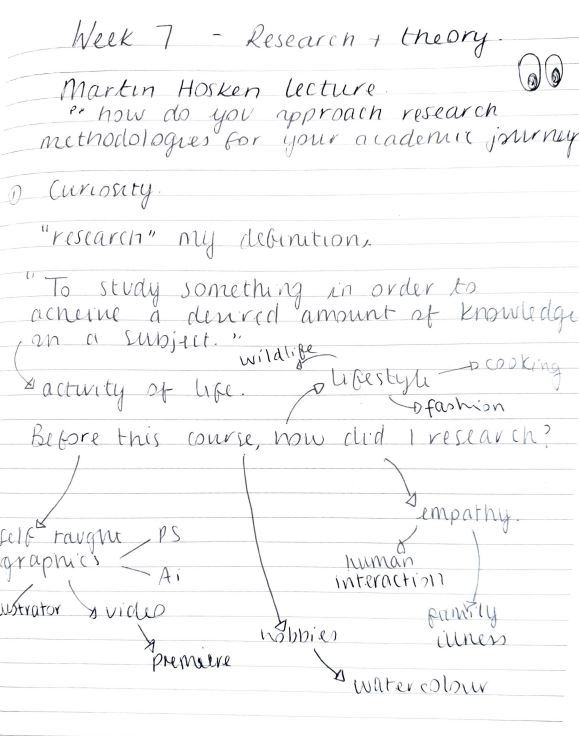


Within his lecture, Martin asked us to stop the video and observe the room which we were currently in. To observe the shapes and colours and to imagine what impact could e emerge if we were to change them.
In reaction to this I decided to firstly created a mind map, exploring my first initial feelings I experienced when stopping to absorb in the room. I then created a list of possible changes I would make – some of which I’m going to follow through!
Lastly I then decided to write a page of small descriptive’s on specific elements of the room.


Martin also spoke about Etymology’s during his lecture and chosen to un-box ‘research’ as an example. After learning the French & Latin meanings of the word – I thought of ways of which I could play with text by illustrating their meanings over and around the letters.
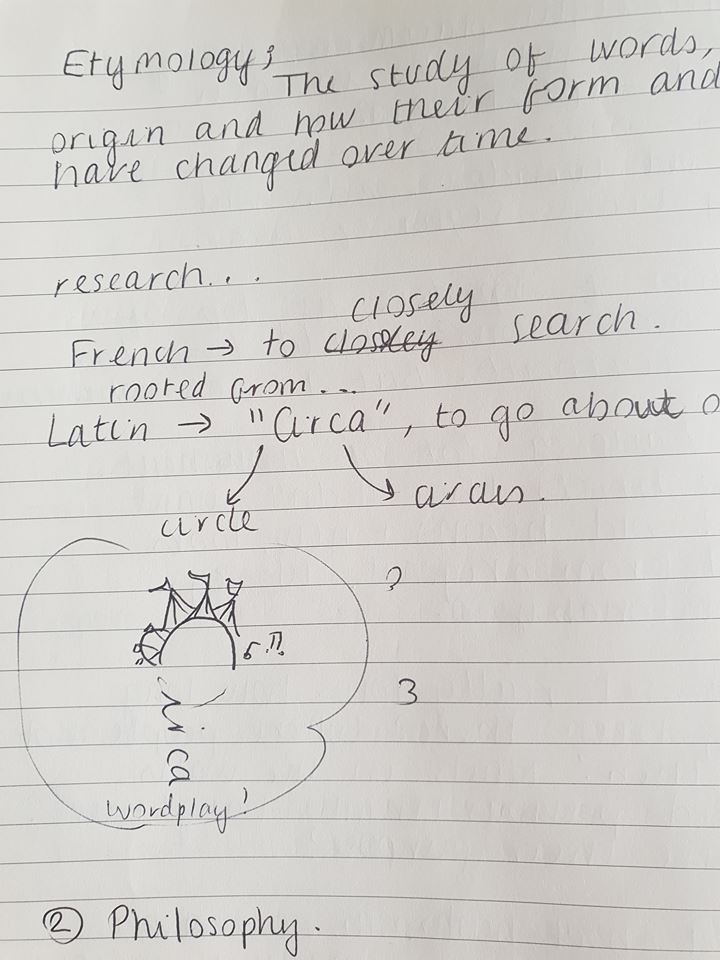
Something I’m certainly looking forward to playing with in the near future.
 Sian Laüra